
Tabla de contenidos
Google is the search engine with the highest search volume worldwide. In the specific case of Spain, it accounts for more than 95% of the total number of searches performed.
To be well positioned, you must know which are the Google’s “rules of the game”, you must know both the factors that will get your pages added to their indexes and displayed among the first results for searches related to your portal, and be aware that these factors have limits.
The limits are determined on the basis of a series of secret algorithms, which Google guards with special suspicion, with the excuse of maintaining fair competition between websites.
Since Google’s algorithms are secret, it is impossible to know exactly the limits of the factors that will make you rank well.
So if you have noticed a sudden drop in organic traffic volume on one of the pages of your portal without any apparent explanation, it is quite possible that this is due to the fact that Google considers it now, following an update of one of its algorithms, overoptimized and that it has therefore penalized with loss of rankings for certain searches.
Google Penalties
Currently we know of two generic types of Google penalties, which differ mainly in the participation or not of a reviewer during the analysis.
Automatic or algorithmic penalties
These are penalties in which no person is involved. They are performed in an automated way based on the data that Google spiders extract from each page. If, according to the search engine’s own parameters, it considers that they do not comply with Google’s quality criteria, they will be penalized with the loss of positions for the terms involved.
Detecting whether a website has been automatically penalized is complicated, since you do not receive any kind of warning from Google.
Keep track of your portal’s position for the most popular searches related to your industry. In this way, if it suffers sudden drops in the ranking you may have indications of possible penalties.
You can also use Barracuda Digital’s “Panguin Tool“ web tool, which works as an extension of Google Analytics (and will ask for access to your account).
This tool will show you on the traffic graphs of any of your profiles the moment in which Google launched any of its updates, so if after an update you observe a drop in the traffic graph, you may have some clue.
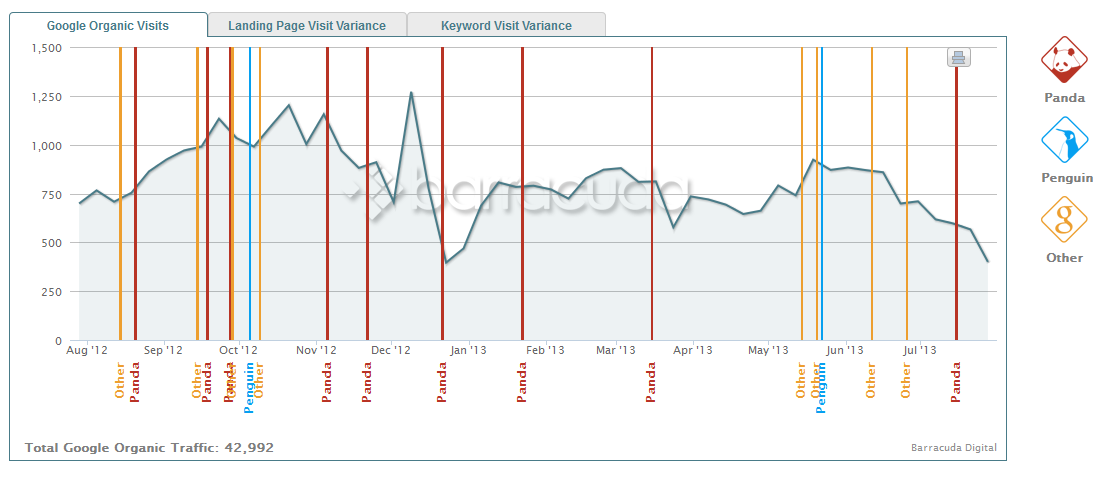
You should keep in mind that it may take several days or weeks after a new update is released before you are penalized, depending on how often Google crawls your site and the geographic spread of the update. If you detect that you may be suffering from this type of penalty, you should review your site to detect which Google criteria you are violating and correct it as far as possible. Your site will continue to be crawled periodically depending on the degree of penalty applied, and if the algorithm deems that the problem has been corrected, the site should begin to improve in ranking.
Manual penalties
In this case, and following a previous complaint or Spam report by a third party, a Google reviewer personally analyzes the portal to detect whether there is over-optimization.
Anyone can report to Google that they have found pages that are over-optimized or practice fraudulent techniques. In this way they try to invite their users to improve the relevance of their own searches.
In this case it is much easier to detect if we have been penalized, since Google sends a warning message to our Webmaster Tools account indicating that we have been victims of a Spam report.
To solve this type of penalties will depend on the type of Spam report you have received, which will condition the possible actions to be taken.
Types of Spam according to Google
- Misleading redirects and concealment
- Compromised site
- Hidden text or text with too many keywords
- Parked domains
- Spam in its purest form
- Dynamic DNS providers and free malicious content hosts
- Content of little relevance with little or no added value
- Unnatural links to a site
- Unnatural links to a site
- User-generated spam
After the corrective actions you should send a reconsideration request to Google from Webmaster Tool, and after a check (again by a reviewer) that the errors have been corrected, the penalty will be lifted and the site will improve in the ranking. It should be noted that Google’ s reconsideration request cannot be used on automatic penalties where you can only wait for the algorithm to recheck the site and deem that the problem has been fixed.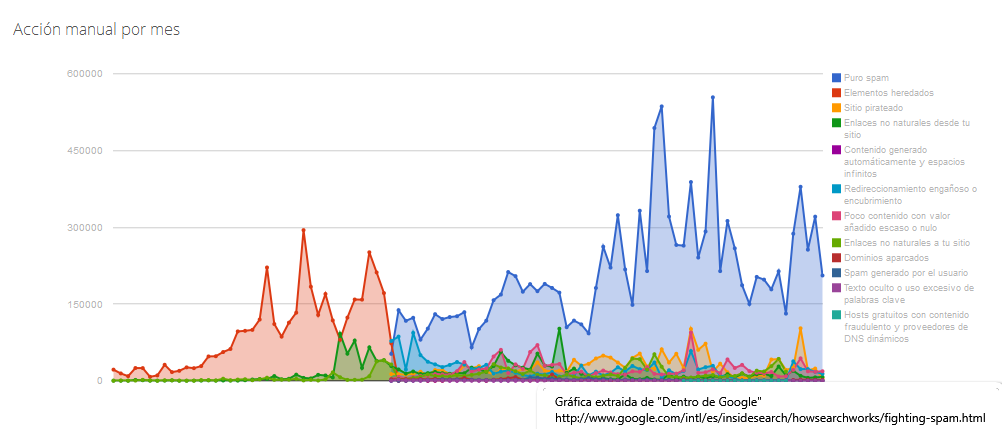
If you do not want to swell the data on Google spam pages and learn more about the types of Spam, make sure you know how the search engine works from the inside, keep an eye on its upcoming updates and algorithms and try to adapt your site to Google’s “rules of the game”.