
Tabla de contenidos
The search engine optimization sector, in its constant evolution, currently finds itself in a rather paradoxical scenario: on the one hand, the global volume of queries continues a historic ascent, while on the other hand, organic traffic directed to external domains is experiencing an unprecedented recession.
The first new reality that is impossible to ignore is: the reign of the click as the supreme KPI has ended. It is no longer enough to be the first option in a list of links; instead, in this new stage of SEO’s strategic maturity, the goal is to aspire to become the answer itself.
This phenomenon, far from representing the end of SEO, marks the beginning of the era of multichannel findability, where visibility on Google’s results page itself is consolidated as an irrefutable corporate authority asset.
The Search Console bug of 2025-2026
There is a recent incident related to analytics that we must keep in mind when discussing zero-click and its impact: the technical anomaly that affected Google Search Console for almost eleven months. From May 13, 2025, to April 3, 2026, a logging error in Google’s systems caused an artificial inflation of reported impressions. Since Click-Through Rate (CTR) is a derived value (clicks / impressions), this bug generated a systemic deflation in the click percentages shown in the tracking dashboards.
This implies that before drawing any conclusions about how zero-click may have affected our domain, we must thoroughly review the 2025 historical data: part of the traffic “collapse” attributed to zero-click was, in reality, a statistical mirage caused by an error in the measurement tool. In this sense, it is imperative to uphold technical rigor as the only defense against misinterpreting corrupt data.
Anatomy of Zero-Click in 2026: Data vs. perceptions
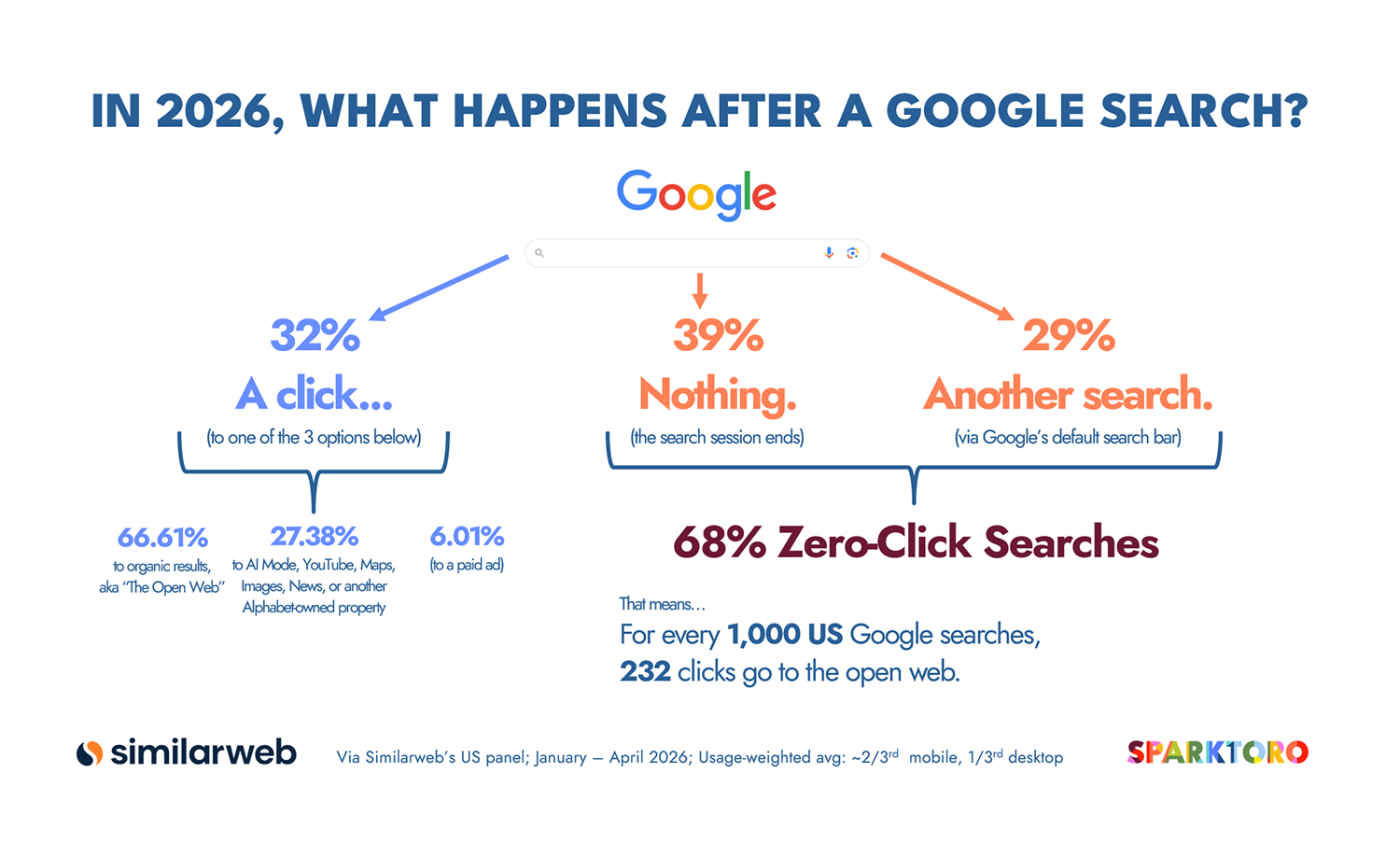
In the current search paradigm, it is estimated that around 68% of queries in mature markets like the US or the EU are resolved without the user ever leaving the Google ecosystem. Upon deeper analysis, however, we discover that this occurs in a rather asymmetrical way: highly transactional or comparative intent searches (especially in the e-commerce sector) show notable resistance to activating AI Overviews. However, when it comes to informational searches (especially those like “how to do x”), we see that the activation rate is almost total, close to 99%.
As we can see, this predominantly affects the top of the funnel. Now, it is up to us to decide how we interpret this new reality: we can view it as purely negative, a visibility crisis, or understand it as a purification of traffic that is often low-value, and use it as an opportunity to reformulate efforts towards attracting qualified leads instead of focusing on vanity metrics.
Optimizing for the generative answer engine
Faced with the zero-click phenomenon, SEO must evolve beyond keywords. We must write with an understanding of how language models “think.” For AI to choose you as a source in its summaries, you need to make it easy: direct sentences, no circumlocution (subject, verb, and predicate), and no ambiguities.
Goodbye to endless filler texts; the key now is to create autonomous information blocks that function as immediate answers. The goal has completely changed: we no longer seek for the user to click and read the entire post, but for Google to crown us as its source of truth to explain the topic to the user with authority and expertise.
From keywords to “semantic entities”
Search engines no longer read texts as if they were a simple dictionary; they now connect concepts, people, and brands as “entities” that relate to each other. What does this mean in practice? It means that implementing structured data (with Schema.org) becomes absolutely fundamental; you must make it crystal clear to the search engine who your organization is, who your experts are, and what solutions you offer.
If you build a solid entity-based strategy, it’s much harder for AI to copy your content and paraphrase it without giving you credit. By properly tagging each piece of information, you make it easy for search engines to link their answers directly to your brand name. In short: classic “domain authority” is losing ground to “entity authority”, which is what the algorithm truly validates.
Survival in the Zero-Click era: where to compete when clicks are scarce
Surviving in Google’s results today requires us to divide our strategy into two very clear fronts.
First, we must dominate the BOFU (Bottom of the Funnel): purchase intent searches and service comparisons remain, to this day, the great refuge for getting clicks, simply because the user needs to visit the website to complete the transaction.
Second, it is essential to create “citable” content. We are talking about providing original data, proprietary studies, or field research that AI cannot replicate by rehashing content from the internet. If you are the original source of a unique statistic, AI will have no choice but to cite you to maintain credibility, which can significantly boost the CTR of your referral links.
Finally, don’t forget branding: getting users to directly search for your “Brand + Product” is the only real shield against zero-click, because it forces the search engine to act as a direct bridge to you instead of retaining your traffic.

The role of EEAT in the AI era
With the internet flooded with AI-generated automatic answers, the “E” for Experience in Google’s EEAT guidelines has become one of our greatest assets. AI is great at summarizing what already exists, but it has no idea what it’s like to live a real experience, provide the keen eye and unique perspective of a specialist, or resolve a complex technical audit in real time. At Human Level, we are clear that the value lies in “expert evidence”: opinions that come from years of real practice and empirical data that no language model can invent or hallucinate. This approach not only protects us from Google penalizing us for weak content but also builds trust with the user that a machine cannot match, which is fundamental in sensitive sectors such as health or finance (the famous YMYL) in particular, but applies to all other topics generally.
How is Google able to validate human experience against synthetic content?
Google doesn’t trust typical AI text detectors, mainly because it knows they are easy to fool and often fail. Instead, the algorithm uses a much smarter concept that we must familiarize ourselves with: information gain. When bots crawl the web and find ten articles that say exactly the same thing but with different words, they assume it’s filler content or an AI rehash. It doesn’t provide anything new to the user.
To detect real experience, the search engine analyzes whether your text provides information that did not previously exist in its database. Human insight leaves traces that are very difficult for a language model to clone: the analysis of a rare exception to a rule, examples from a specific real-life experience related to the topic, or screenshots of a real control panel. The algorithm rewards this deviation from the norm; if your content breaks the predictable, flat pattern of AI by providing real value, Google classifies it as genuine, high-quality information.
The new standard of strategic SEO
In summary: SEO is not dead (again); it’s just taking the next step to become more strategic than ever. The game is no longer about getting clicks at all costs, but about gaining visibility. Therefore, we must forget about raw visit volume and start measuring our market weight and brand reputation with AI.
Organizations that understand this change in time and invest in clean technology, reliable data, and clear, truly useful content will not only survive the zero-click era but will also lead the market.
Ultimately, success is no longer measured by how many people simply browse your website, but by who controls the conversation on the internet. Instead of lamenting lost clicks compared to previous periods, we must ensure we leave our mark on the answers provided by AI and lead the narrative in our sector.