Tabla de contenidos
- The challenge of sectors with low search potential
- The pre-AI stage: building authority through a content architecture
- Paradigm shift: the impact of LLMs and the new digital scenario
- Knowing who is searching for us: Audience Research and Searcher Personas
- Digital PR: actions to impact, generate authority, and brand consensus
- Conclusions: SEO as an educational and trust tool in B2B environments
Doing SEO today is significantly more complex than it was just a few years ago. However, when we dive into projects aimed at specialized and niche B2B markets, the technical and strategic challenge escalates to a higher level. In these environments, it is not enough to optimize for people and algorithms; we must optimize for complex decision-making.
At Human Level, we want to explain how we have managed and are evolving these types of projects, adapting our methodology to continue impacting our clients’ target audience, even when the rules of the game change drastically.
The challenge of sectors with low search potential
There are business verticals so specific that search volumes are residual. Often, we encounter a critical scenario: the target audience itself does not know the technical terminology necessary to find the solution to their problems. These are emerging or highly specialized markets that, moreover, lack the massive budgets of mass-market awareness campaigns.
In this context, SEO becomes the most efficient entry point, but it requires a change of mindset. The first thing we do at the agency is educate the client: SEO here is not a light switch, but foundational work that requires total technical involvement from both parties.
Why traditional keyword research fails in technical markets
The most common mistake is discarding terms due to their “low volume.” In niche B2B, a keyword with 10 monthly searches can have an infinitely higher conversion value than a generic one with 10,000. These are functional terms that meet qualified visibility goals.
The real problem arises when the potential user does not even know that a solution exists. Here, keyword research based on traditional tools fails because there is no conscious demand. We must shift from looking for “what the user is searching for” to understanding “what problem they are trying to solve.”
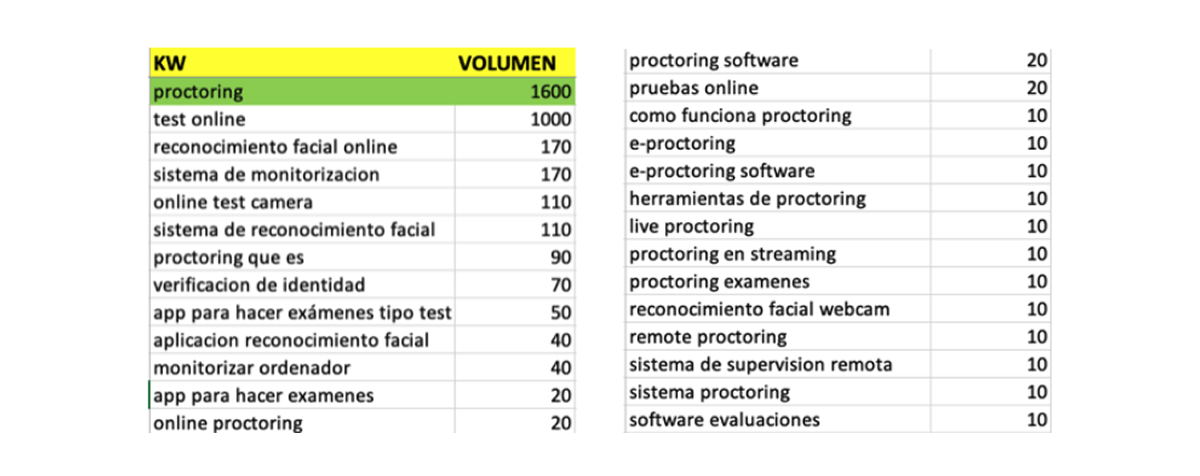
Proctoring software as an example of a specialized niche
A real example we have worked on at the agency is the proctoring software market. For those who are not familiar with the term, proctoring consists of automated or online supervision of exams and assessments, using technologies like facial recognition or behavioral analysis to ensure academic integrity.
It is a niche where the potential client usually looks for solutions for “online exam fraud” or “certification security,” unaware that there is a technology category called proctoring. The strategic success we will explain in this article would not have been possible without a perfect symbiosis: the technical and strategic vision of our team at Human Level and the deep product knowledge of our client’s team.
Our initial strategy for the proctoring brand was clear: to build from scratch a content ecosystem capable of intercepting the user in their discovery phase. We designed an architecture of indexable informational categories aimed at two large clusters: educational institutions and HR departments of large corporations.
We distributed our efforts across three key markets: Spain, the US, and Latam. By identifying topics of high interest for the buyer personas, we maintained a publication frequency of 8 pieces of content per month. The results validated by data were exponential, going from 300 clicks in 2022 to 70,000 in 2024.
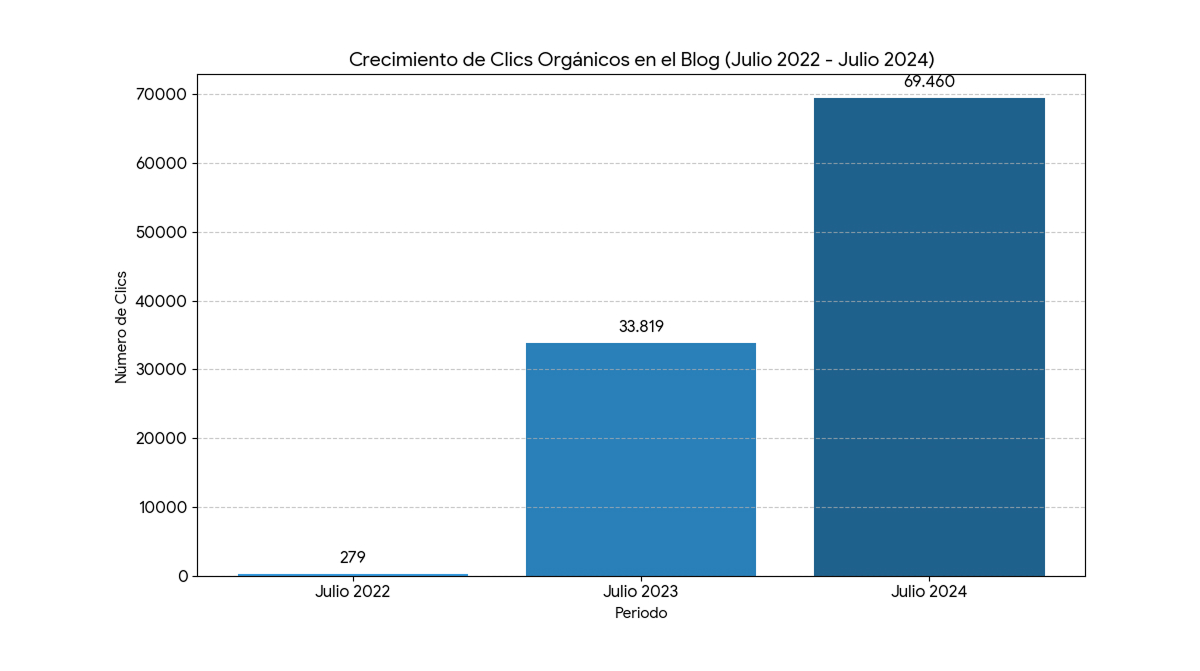
The growth in organic traffic was on par with the increase in leads and demo requests. The traditional content strategy, based on search volume and publication frequency, was working at full capacity.
Paradigm shift: the impact of LLMs and the new digital scenario
However, 2025 has brought with it a structural transformation of the digital ecosystem as we knew it until now. The emergence of language models (LLMs) and new search interfaces have redefined what it means to “be visible.”
From organic traffic to the loss of informational clicks
Despite having a solid foundation, we observed a new phenomenon: the appearance of AI Overviews (AIO) on Google. Although our client’s brand was frequently cited in the AI-generated responses thanks to the semantic authority we had built, direct traffic to the blog was diminished. The user now gets the answer to their more generic questions directly in the SERP, eliminating the need for the basic informational click.
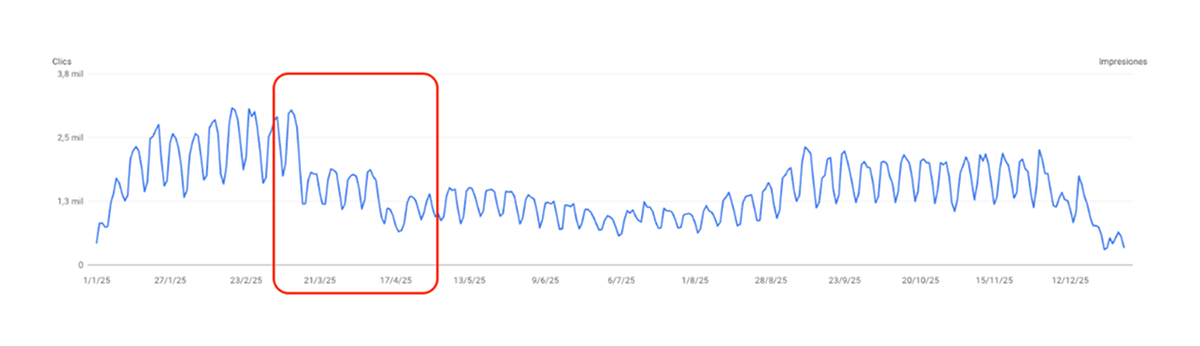
However, the most revealing data for our strategy is that, although informational clicks have dropped, conversions have not. This confirms that the traffic we are losing is the one with the lowest commercial value, while the user with a real business need continues to reach our service or contact pages. We have gone from attracting “readers” to filtering “decision-makers.”
The data from July 2025 reflected this reality, with a drop from 70,000 clicks (July 2024) to 30,000 clicks. Faced with this scenario, we made a strategic decision at the agency: to prioritize depth over frequency.
We went from publishing 8 articles per month to just 4, but transforming them into pieces of exhaustive technical authority. We reinforced EEAT (Experience, Expertise, Authoritativeness, Trustworthiness) through:
- Real author pages: signed by the company’s specialists, validating their track record in the sector.
- Case studies: documenting the brand’s practical expertise by expanding the blog architecture with two new categories: case studies and technical content related to the niche.
- Expansion of semantic authority: we went from a few corporate URLs to nearly 100 detailed service pages, designed not only to capture traffic, but so that search engines and LLMs understand the brand’s knowledge architecture.
Knowing who is searching for us: Audience Research and Searcher Personas
In this new ecosystem, we have evolved our methodology. It is no longer enough to know what is being searched; we need to know who is searching and where they consume information. As we have been studying and analyzing how LLMs “think,” we at the agency have adapted our processes to include reports that focus on the user without neglecting search demand.
This does not mean we have abandoned content publication; on the contrary, we continue to generate high-value pieces on the blog, but now we fit them with greater precision within the information architecture we originally deployed. Thanks to the fact that we designed a scalable architecture, we have been able to expand it with new categories organically, allowing each new piece of content to reinforce the brand’s semantic authority and be easily interpretable by both humans and language models.
Analyzing user behavior
For the US market, we integrated Audience Research tools like SparkToro. This allowed us to discover that our audience was not just on Google; they also consumed content on specific platforms and technical forums. This multi-channel vision allows us to propose formats that go beyond text, adapting to an environment where search is fragmented.
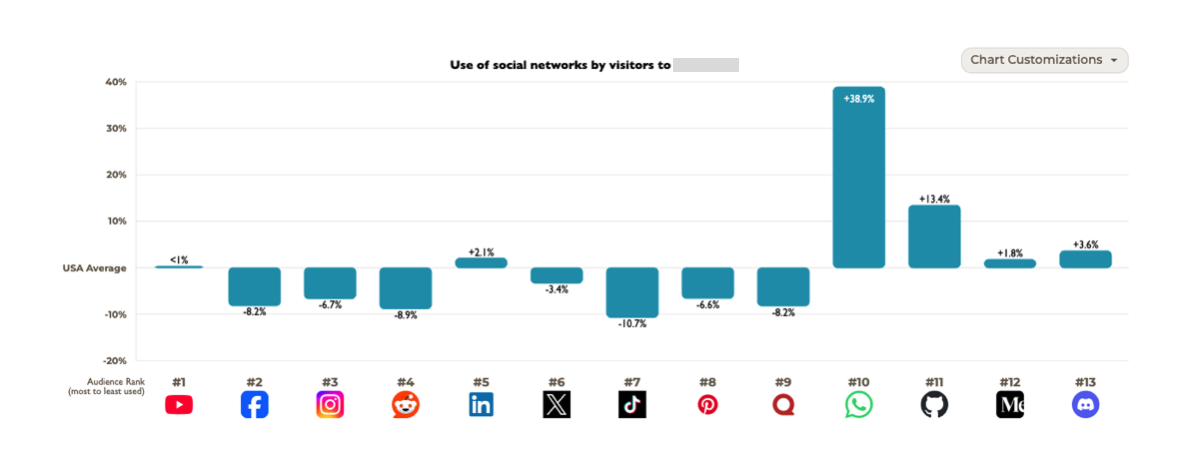
Zero Search Volume searches
Using this data-driven approach, we identified hyper-specialized Searcher Personas profiles. This allows us to tackle Zero Search Volume topics. These are queries that traditional tools ignore due to a lack of historical data, but which are vital in the AI era. The goal is to cover the “query fan out”: those multiple ramifications of synthetic queries that the LLMs themselves make from a prompt launched by a user on AI platforms and which require our brand to be the source of truth.
Finally, we understand that for an LLM to cite our client without the user explicitly mentioning it, we need brand consensus. Through Digital PR actions, we seek to achieve presence in external media. If the brand is mentioned recurrently and consistently in external authoritative sources, AI models will recognize it as a consensus authority, including it in their recommendations and generated responses as a priority over the competition.
Conclusions: SEO as an educational and trust tool in B2B environments
The final goal has evolved: we want our client’s brand to be the one that knows the most about proctoring, both for traditional search engine bots and for AI agents.
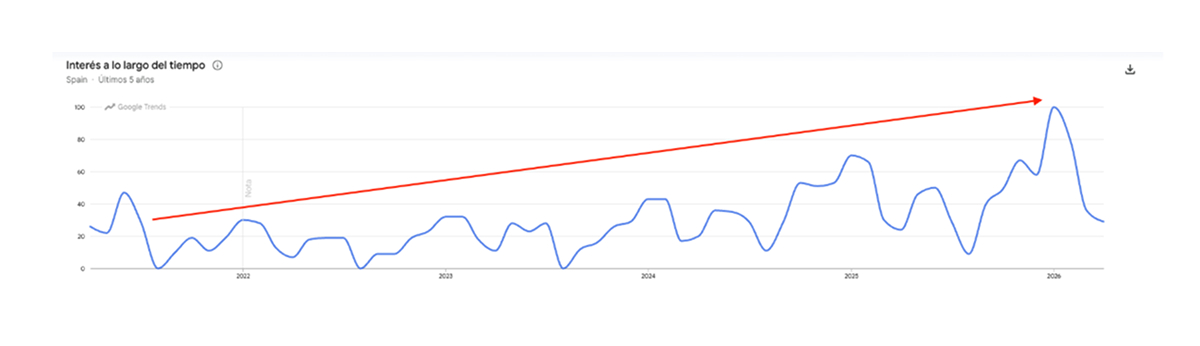
This trajectory has transformed a previously unknown company into a benchmark in its sector, as demonstrated by the increase in brand interest on Google Trends. In niche B2B, SEO is no longer just about clicks; it’s about building the necessary trust so that, when an end customer needs a solution, we are the only possible answer.