
Tabla de contenidos
The concept of the buyer persona has always been present in the work methodology we use at Human Level. In my presentation Customer Journey Analysis and Search Scenarios, which I presented at The Inbounder back in 2016, I already anticipated that the purchasing decision process had stopped being linear.
The use of AI platforms as online search tools has led us to revisit this concept, which now takes on enormous importance. In my recent presentation Personas: New Findability Opportunities for the Sistrix Digital Marketing Meetup in Madrid, I presented a reflection that completely inverts the process and has led us to a methodological shift: instead of starting from a keyword analysis, we should begin by understanding our searcher personas—that is, the customers who are searching for us. And artificial intelligence becomes the perfect ally to achieve this. Let’s see how we have put this new perspective into practice at Human Level.
The Problem: Search Has Fragmented
Traditionally, we worked under the hypothesis that SEO was, to some extent, predictable. We selected ranking goals based on keywords with measurable search volume, we knew what positions we occupied on Google, and we optimized with the aim of improving them. The process was linear: keyword research → grouping or clustering by search intent → technical and semantic optimization → strategic creation of new content.
But that scenario has changed drastically. As we see in Figure 1, search habits have fragmented across multiple platforms: traditional search engines, aggregators and marketplaces, social networks, AI chatbots… each with its own dynamics. And most importantly: while only Google shares search potential data for various queries, the prompts used in AI platforms are conversational and extremely specific (zero search volume). And their results are highly personalized.
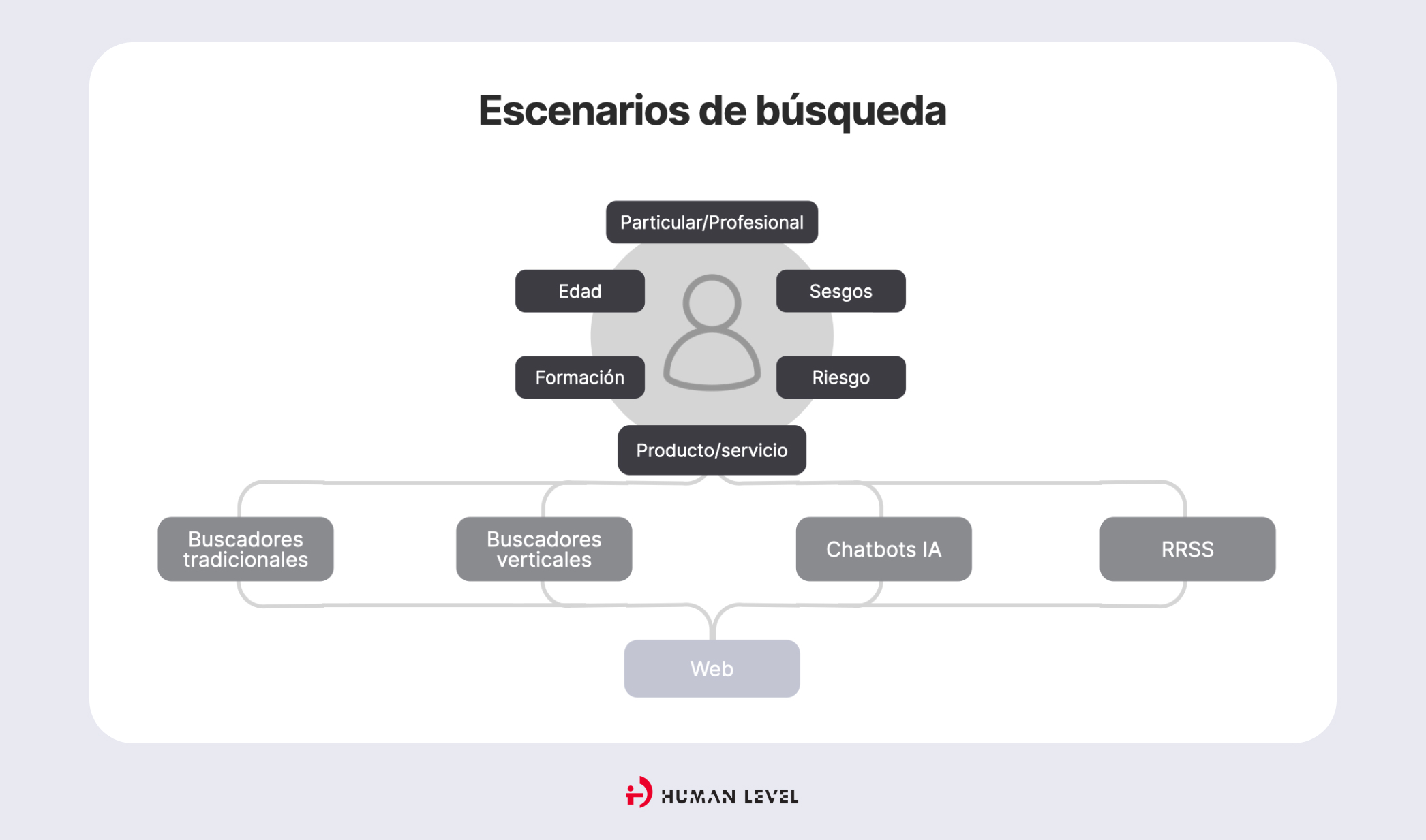
Let’s think of a concrete example. On Google, someone interested in smart lighting would search for something like “smart lighting system.” Now, that same person might ask ChatGPT: “What is the best smart lighting system for a home theater room that doesn’t interfere with video games and works with Alexa?” We have moved from generic searches to an “ultra-long tail” of queries that is impossible to measure with traditional tools.
SEO Challenges for Ranking on AI Platforms
The growing use of AI chatbots as online search tools opens up new challenges for SEO:
- No traditional metrics: there is no search volume data for AI prompts. We cannot know how many people are doing a specific search or measure its popularity the way we did with Google.
- Results are unpredictable: the answers generated by artificial intelligence are personalized and stochastic—that is, non-deterministic. The same question will generate similar but different responses each time, citing different companies or products.
- The “query fan-out” phenomenon: when we perform a simple search, the AI internally breaks it down into multiple personalized micro-queries based on our context, our query history, and personal preferences. Even if the user writes a short question, the AI chatbot is actually processing something much more complex.
All of this leads us to a situation we could call “strategic blindness”: we don’t know what users are searching for, nor how many are searching for it, nor if we appear in the results, nor for whom we appear.
Paradoxically, this apparent limitation has led us to do something we should have been doing all along: stop obsessing over keywords as a starting point and focus on truly understanding people. And this is where our methodology has taken a turn.
The Solution: Inverting the Process
Faced with this situation of strategic blindness where our goal is to be mentioned or linked in AI-generated responses for prompts that we cannot anticipate or measure, the starting point cannot be keyword research but rather deeply understanding our potential customer’s purchasing decision process.
As my friend and professor Paco Cabrera, one of the leading figures in marketing in Spain, always says, “marketing is looking at your business from your customer’s shoes.” And that is precisely what we need to do now, but taking it a step further: using AI not only to step into the customer’s shoes but to understand all the different paths each type of customer takes when searching.
Once we are familiar with their profiles, we can anticipate their needs and, finally, create the content that AI platforms will need to offer them as an answer.
From Buyer Persona to Searcher Persona
This is where a concept coined by Vanessa Fox in her book Marketing in the Age of Google comes into play: the searcher persona. While the traditional buyer persona focuses on the ideal customer for our business, the searcher persona focuses specifically on the person searching online to resolve a need. A potential customer who now, in front of an AI chatbot, can describe it in a much more extensive, personalized, and specific way.
Following the example of smart lighting systems, this would be our ideal profile:
Carlos, the digital optimizer: seeks energy efficiency, mobile control, and time-saving automations. His main objection might be the initial price, but he values long-term savings.
And this would be his searcher persona:
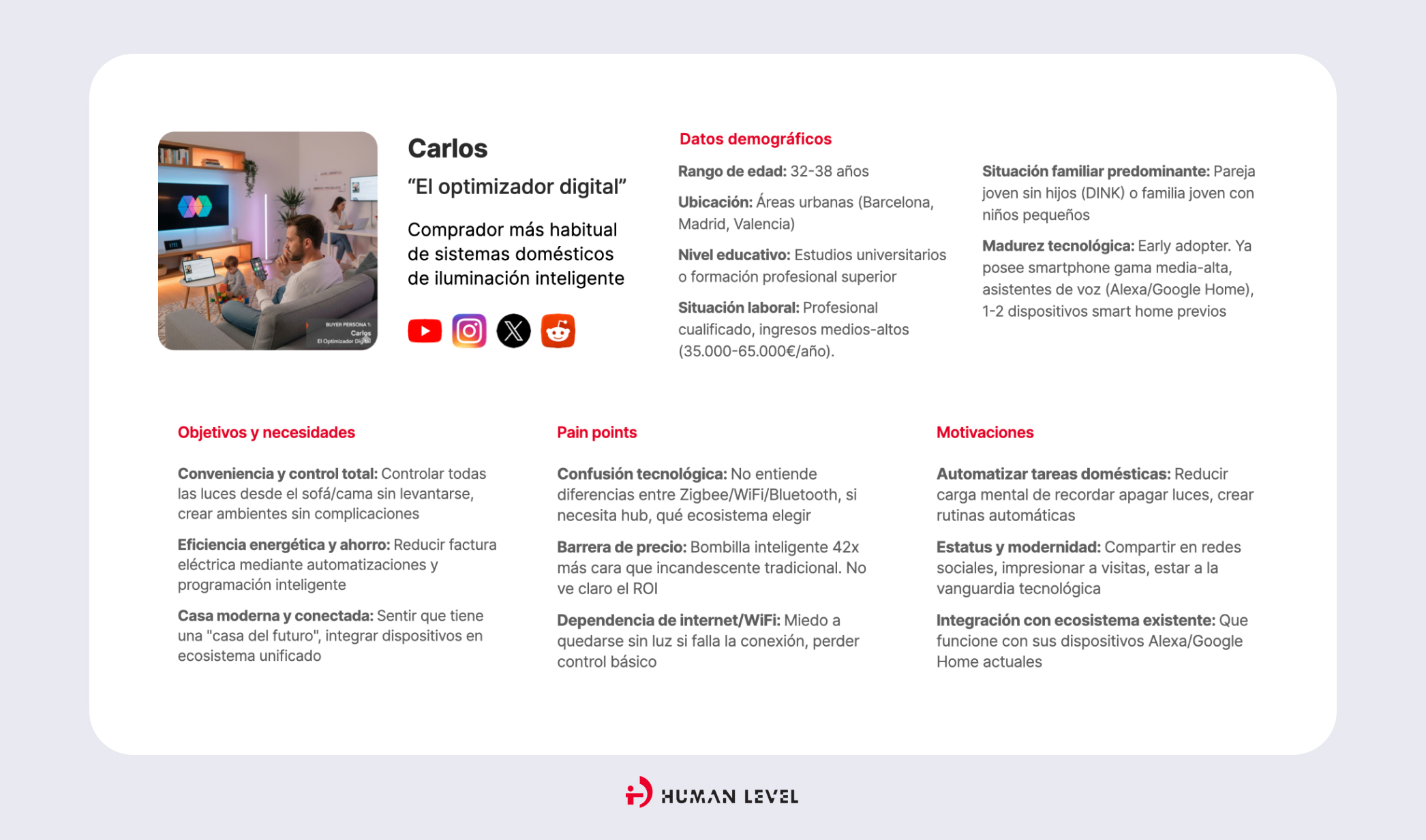
Searches with AI chatbots, however, introduce a key difference. It is no longer enough to create a single generic and static ideal customer profile; instead, we must be able to imagine multiple hyper-specific and relevant profiles, each of which will respond to its own:
- Motivations: those reasons why this profile would want to consult our content, buy, or hire our product or service. We create content that reinforces these motivations.
- Objections: the friction points, doubts, or fears that could stall their purchasing decision. We create content that answers their questions or counters these objections.
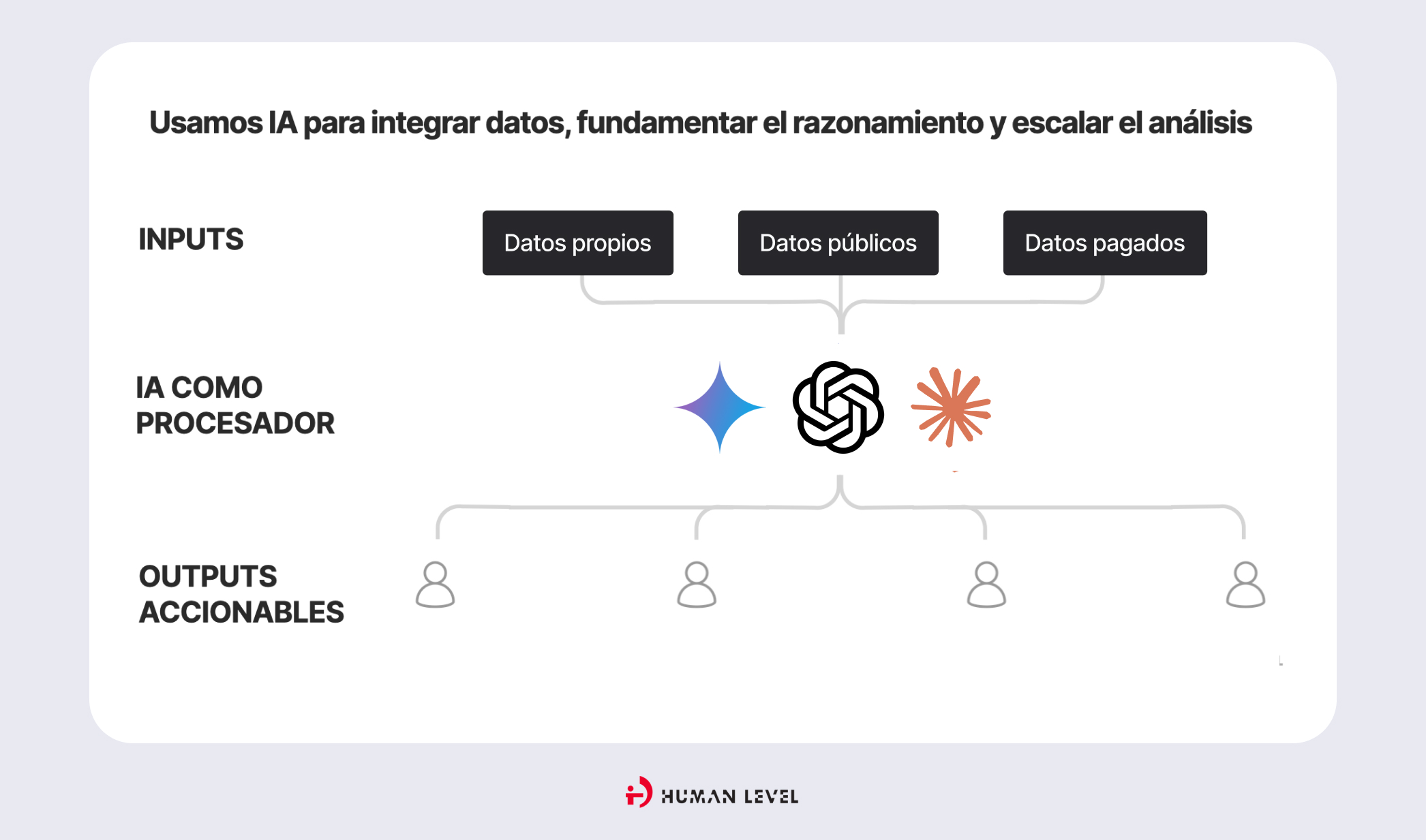
At Human Level, we have developed a three-phase process that combines multiple data sources and artificial intelligence analysis to create precise and actionable searcher persona profiles:
How to Collect the Necessary Information
At Human Level, we have found that relying on a simple prompt for AI to help us create these searcher personas yields rather generic and poor information. In other words, if we don’t feed it relevant and verifiable context, we risk building our potential customers out of mere hallucinations.
To build these profiles with rigor, we need data. Lots of data. But not invented data, rather real information that we can obtain from three main sources:
First-Party Data
These are the most valuable because they come directly from the company itself and from multiple interactions with its real customers.
Here we include, for example:
Support and Customer Service Information
Recurring queries, sales pitches that work, the most frequent complaints, justifications for product returns or contract cancellations… All of this is pure gold for understanding our customers’ real pain points.
Google Search Console
Using regular expressions, we can extract real informational searches that users posed on Google. These searches reveal the actual doubts and concerns of website visitors.
We apply regex like the following in Google Search Console to discover these informational searches:
(?i)^(what|who|which|where|when|how|how\s?much|why|guide|tutorial|course|learn|example(?:s)?|definition|meaning|list(?:s)?|comparison|vs|difference|benefits?|advantages?|alternatives?|best|top?)\b.*
For example, a query related to the compatibility of our product with other systems would be providing us with information about a key doubt our customers have before making their purchasing decision.
Google Analytics
Especially the searches performed on the website’s internal search engine. When someone searches within a website, a need not met by their navigation becomes evident.
Public Data
The internet is full of valuable information if we know where to look. For example:
Studies published online: using specific search patterns like the ones below, we find studies on consumer trends, buyer profiles, or user behavior in many sectors. Tools like Deep Research in Gemini also help us discover relevant sources in any field.
consumer trends [sector] - [sector] industry trends - buyer profile [sector] - buying trends in [sector] - [sector] buyer study - [sector] market study - [sector] industry analysis - evolution of [sector] sector - Etc. Optional: filetype:pdf
These analyses provide us with valuable information about user profiles we might not have considered, such as the possibility of including a smart lighting system as a draw to make a property more competitive in the rental market. When necessary, we narrow down results by including date filters so only recent studies appear or by specifying the required geographical scope.
Forums and Communities: platforms like Reddit are gold mines for information on how users really talk about certain products or services. The questions they ask, the vocabulary they use, the objections they raise…
Reviews on Marketplaces: opinions on Amazon or other marketplaces, for example, reveal what features users value, their most frequent doubts, and what problems they have encountered.
Purchased or External Data
If we need to go even deeper, we can turn to:
- Ad hoc industry studies: specific market research that we can commission or buy from specialized consultancies.
- Specialized tools: for example, we rely on data from platforms like SparkToro (to understand audiences), SimilarWeb (to analyze behaviors), Also Asked, or Answer the Public (to discover related questions).
Of course, after this document collection, we will have accumulated a massive volume of information from multiple sources and in different formats, which exponentially complicates its analysis to extract the most relevant insights for creating our searcher personas.
And this is where AI comes into play. The data provided by these studies are key to preventing the obtained answers from including invented information. Linking our recommendations to real verifiable data gives them greater credibility and helps us prioritize their implementation.
Let the AI Work Its Magic
Just as AI is prone to hallucinating and “slipping in” invented information in its responses if we pose simple prompts without providing context, it can also become our best ally in carrying out the overwhelming task of combining, analyzing, correlating, and synthesizing the information collected from the first-party, public, and purchased data we just listed.
Prompt Example:
“Help me define the buyer persona for someone purchasing [product]. The goal is to understand the main motivations, objections, and doubts of a [product] buyer. We will use this information as a basis for designing an online findability strategy for [company]. Act as an expert market analyst in [sector] and use the documentation in the attached files to justify your recommendations. Define the ideal buyer persona for this type of [product] and describe it in a way that an SEO consultant can understand.”
We have found that this type of initial prompt usually gives us a solid base, but the true value is obtained through iteration: next, we ask the AI to delve deeper into the motivations and objections of different profiles, to identify patterns in the reviews we have collected, or to cross-reference information from different sources to validate or discard hypotheses about our users.
With all this information, we are indeed in a position to obtain truthful and grounded answers to:
- Generate detailed user profiles: based on all the collected data, the AI helps us identify patterns and create coherent and realistic profiles.
- Discover opportunities: by analyzing large volumes of information, the AI detects behavior patterns, correlations of purchasing decision factors, or audience segments that we likely would have overlooked.
- Anticipate searches: once the different searcher persona profiles are identified, the AI helps us foresee what kind of searches each would perform in each phase of the funnel.
- Translate technical features into distinct advantages for each persona: one of the most practical uses we have found is “translating” a product’s technical specifications into specific benefits for each user profile.
Practical Example: Smart Lighting Systems
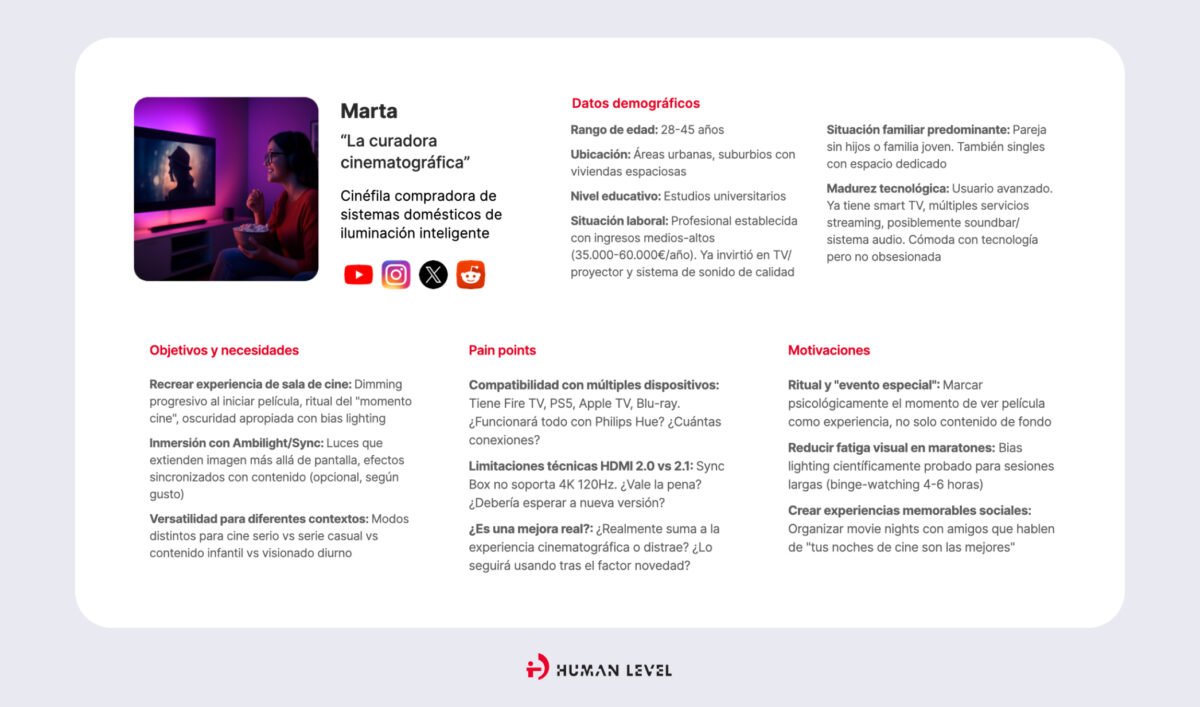
In my presentation, I took as an application example the type of product sold by one of our clients. Instead of creating generic content about “smart lighting,” the process I just described would help us imagine distinct searcher personas, with their own goals, needs, motivations, and objections. To the generic profile of Carlos we saw earlier, we would add other more specific ones:
Marta, the curated cinephile: wants lighting that recreates the home theater experience, with predefined scenes for different movies. She is concerned about setup complexity.
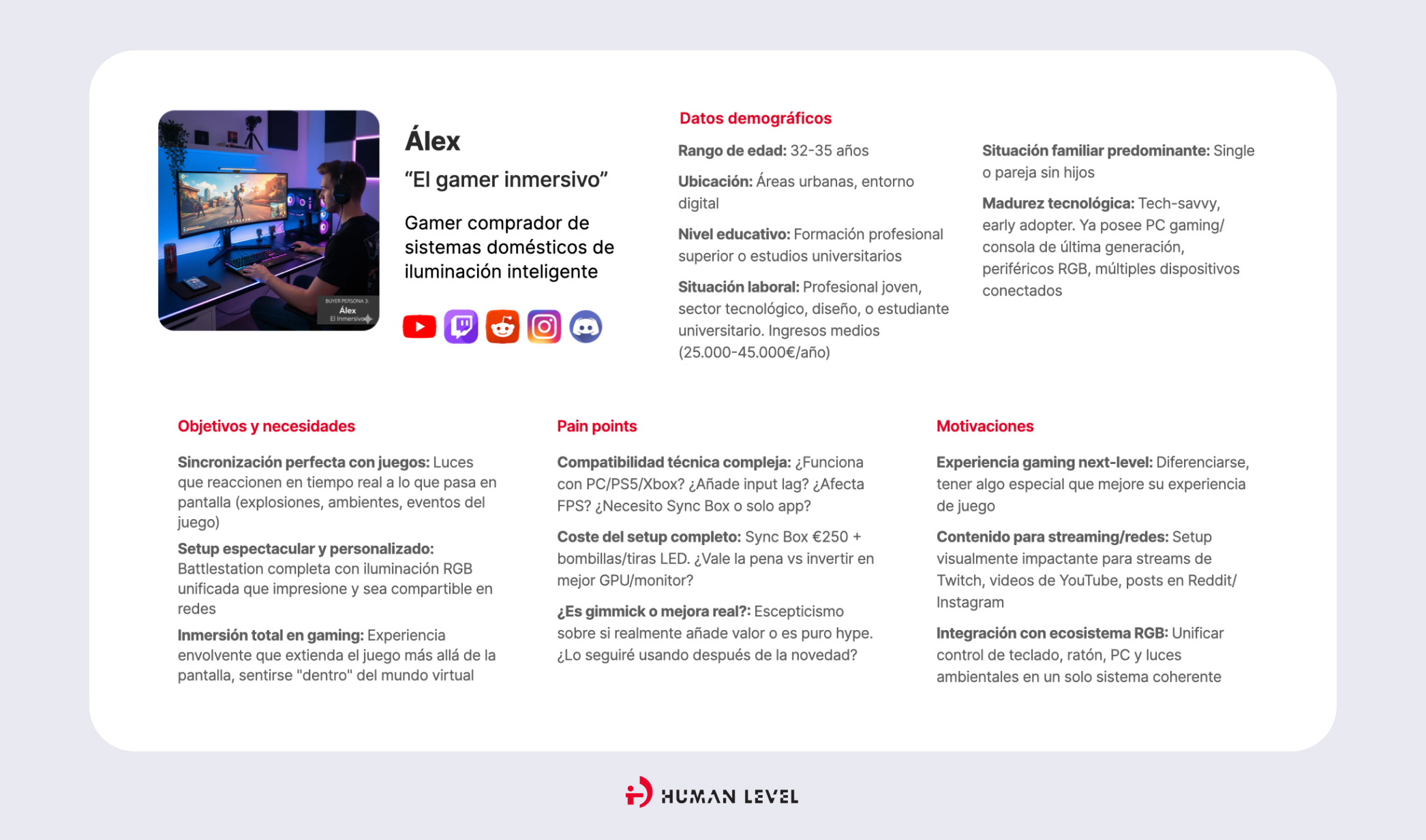
Alex, the immersive gamer: needs lighting reactive to games, with no latency, that works with his streaming platform. His objection might be compatibility with his current hardware.
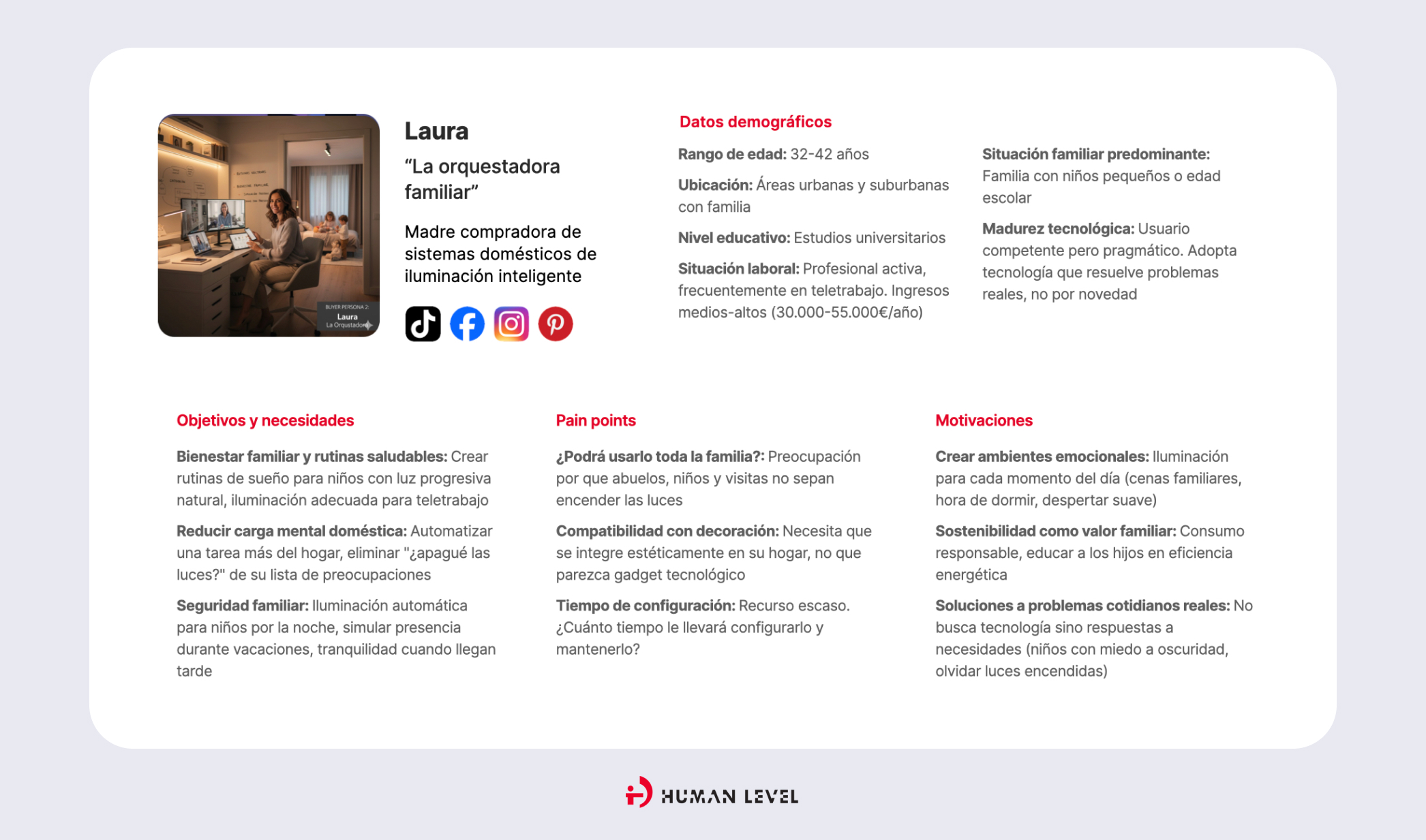
Laura, the family orchestrator: seeks solutions that the whole family can use easily, including children and the elderly. She is concerned about security and data privacy.
Antonio, the contemplative audiophile: values light quality, circadian cycles, and the ability to create environments for listening to music. His main objection is the design and aesthetics of the devices.
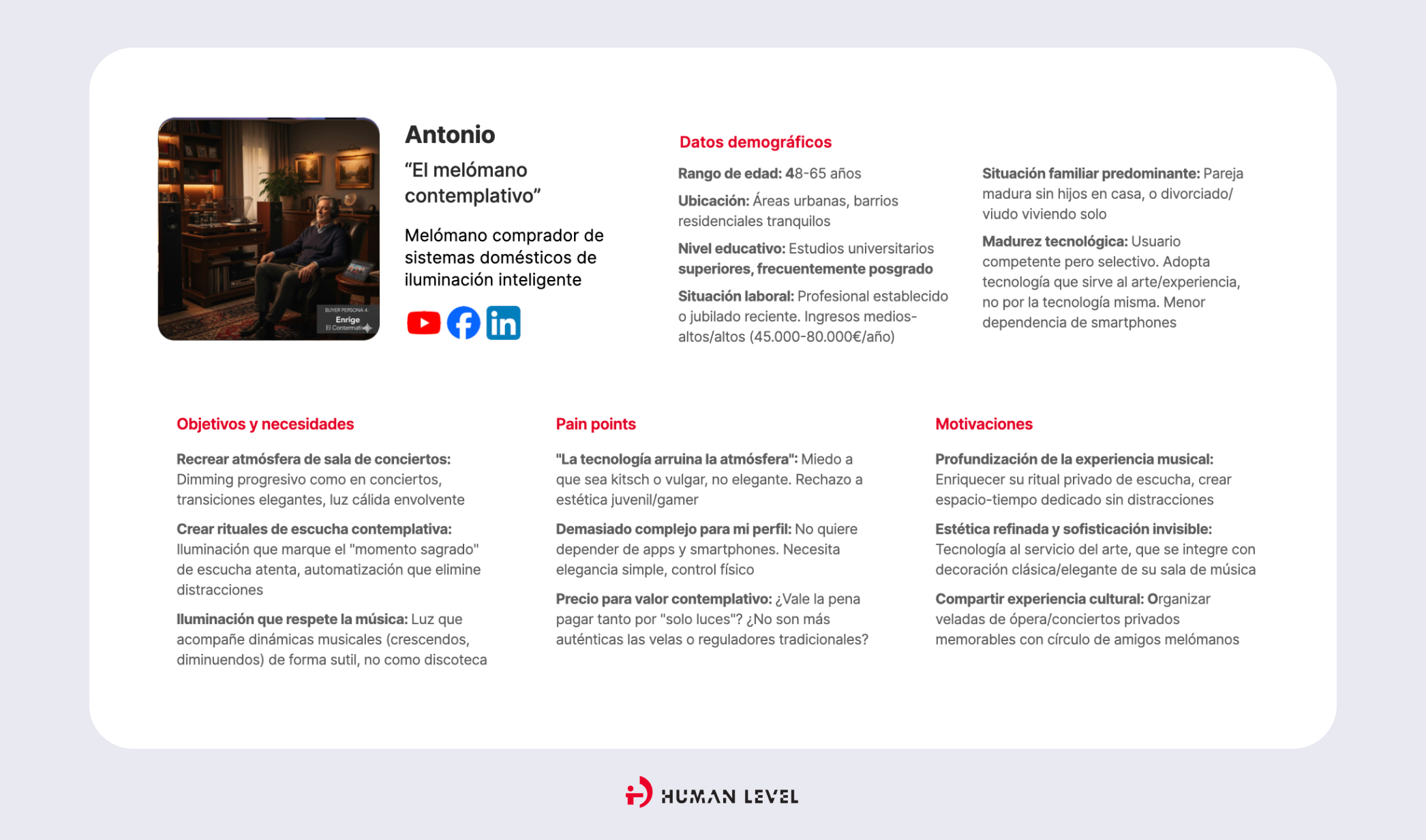
For each of these profiles and based on all the information already gathered, it becomes easy to create detailed profiles with their goals, friction points, and motivations. Then, we pose the “What if?” question to explore new combinations: What if someone is a cinephile AND a gamer? What if they are an audiophile AND a digital optimizer? Etc.
Practical Applications in a Findability Strategy
This update to our methodology opens up multiple possibilities for website optimization:
- Adapt product pages: instead of listing generic technical features, a product page can present specific information that responds to the needs of each profile. This doesn’t mean creating different pages, but ensuring that all relevant information is present so that the AI can detect it and offer it when pertinent.
- Create segmented content: for strategies aimed at very different segments, or for companies with multi-domain strategies, we can offer each profile content aligned with their own searcher persona characteristics.
- Feed the AI with context: when the AI breaks down a complex search into micro-queries through the query fan-out process, it will try to find specific answers in our content. If we have worked on these profiles in depth, it is more likely that our content will answer those micro-queries and we will be cited or linked in the generative response to ultra-long tail searches.
- Optimize information architecture: understanding each profile’s search patterns helps us better structure our website and make it easier for both users and AI to find what they are looking for.
The Future: Automation with AI
This methodology might seem laborious at first. However, with tools like Gemini Gems, the use of well-constructed system prompts, or Claude’s project structure, we have created workflows that:
- Process data from multiple sources.
- Generate user profiles based on real patterns.
- Suggest attribute crossovers to discover new profiles.
- Propose specific content for each searcher persona.
Adopting this new perspective involves a significant shift. Through training sessions and mentoring processes, our consultants are creating these hyper-relevant profiles in each of our projects to refine a methodology that always develops from people, not from keywords.
The Key: People at the Center of the Strategy
Marketing has always been about putting the customer at the center. SEO and, more broadly, online findability as part of marketing, must follow that same principle. And in a world where searches are increasingly conversational, personalized, and fragmented, and we lack the data that guided us until now, understanding our potential customers’ search process becomes more crucial than ever.
Artificial intelligence does not replace the need to know our audiences. On the contrary: it makes it more important. But it also gives us the tools to do so—based on context analysis—more deeply, efficiently, and precisely than ever.
So next time you have doubts regarding your website’s visibility goals on AI platforms due to a lack of data, ask yourself: am I starting with keywords or with people? At Human Level, we have already chosen our answer.
This post is a summary of my presentation “Personas: New Findability Opportunities,” which I gave in November 2025 at the Sistrix Digital Marketing Meetup in Madrid:
Want to see how to apply this searcher persona methodology to your specific project? At Human Level, we have already incorporated it into our online findability routines. Contact us so we can help you.