
Tabla de contenidos
During 2025, generative AI has evolved from an emerging trend into a central element of user search behavior. AI tools no longer just generate answers: they influence decisions, summarize information, maintain conversations as deep as the user demands, and filter which content deserves visibility.
In this context, we review the weight of content quality and its role in how LLMs (Large Language Models) perceive a project’s digital resources.
Is content quality still a differentiating factor in the age of Artificial Intelligence? Or is a better strategy the mass generation of automated content to quickly cover any search performed by our buyer persona?
Recent data and statements from Google, Microsoft, and leading industry analysts provide a clear answer: “yes, quality is more important than ever.”
Google has just released its 2025 search data in its “Google Year in Search 2025.” This annual summary confirms that Artificial Intelligence-related searches are at the top. They are trending: users are increasingly interested in these technologies, platforms, language models, tools, and, ultimately, the possibilities and new scenarios they open up. Today, we all know someone from a sector outside of SEO and Marketing who constantly uses an LLM to support specific tasks.
As interest in these platforms grows, the importance of being cited as a reference source in the results of major AI models naturally grows as well.
Quality and content for humans… from the start
The importance of ensuring the content we generate is of high quality has been tirelessly defended for some time, especially since the rise of LLMs and generative AI responses.
We won’t just stick to the cliché. We are getting down into the trenches once again to break down what “quality” content actually means.
We can define quality content as that which:
- Fulfills the mission for which it was conceived.
- Is well-crafted, well-argued, and demonstrates a solid knowledge base.
- Brings freshness and originality to the information available up to that point for that topic or query.
- Helps the user resolve their search intent with reliable information. Therefore, it will close the search process with a valid answer.
Other factors, such as implementing structured data markup or working on EEAT (establishing author bylines…), will help Google perceive the quality of the content and trust it.
… because “humanizing” is not enough
A widespread practice is to generate content with AI and subsequently “humanize” it through slight tweaks by a human writer.
Changing a headline or the order of a sentence is often conceived as a task that “fixes” the problem of content written by Artificial Intelligence. It is paradoxical, on the other hand, to seek a solution to a problem chosen by the person preparing the content.
In this regard, John Mueller, a Search Analyst at Google, stated in a Reddit comment that rewriting AI-generated content “won’t change the site’s ranking on Google.” He added that what matters is the value that the content adds to the website. In this sense, the importance that Google has always given to “helpful, reliable, people-first content” is well-known. That is, valuable content.
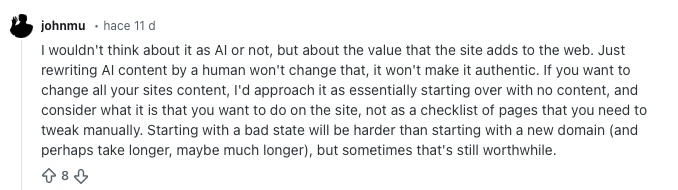
The importance lies not so much in how the content is generated, but in the value it brings to the website and the indexed information ecosystem on that topic.
If we manage to generate a post via AI that provides new data, positions, or a new point of view on a specific topic, the fact that a human didn’t write it will likely not be an issue. Logically, to achieve this type of content, more time and money must be invested, which is why it stands out from the majority of “low-cost” content that is so abundant now.
In certain cases where information is structured and there is less room for creativity, such as a product sheet, an automated use of AI will indeed allow us to save time in text generation without losing value.
No, tricks to simulate “fresh content” don’t work
Content quality encompasses not only what is told but also how recent the information is.
Manipulating publication dates or modifying informational content (mainly blog articles) is a strategy that was very widespread for a long time.
Today, as the outlet Search Engine Land reminds us, the dates set within the content itself, as well as in meta tags and structured data markup, are a signal of “freshness, credibility, and relevance” for Google.
Manipulating these dates without significant changes to the content will not only have no effect but can seriously compromise trust in the quality of our content, create inconsistencies between visible dates, schema, and meta tags, and negatively affect its relevance.
Factors that will actually provide freshness, relevance, and currentness to content are new data that we incorporate (likely replacing previously published data), real content updates, or editorial changes with a solid foundation. These will help the user and, therefore, will be a factor in favor of visibility from Google’s perspective.
Generative AI and content citation: value-oriented quality
The importance of content quality is further reinforced in the field of generative AI search.
In a recent post on the Microsoft blog, Fabrice Canel and Krishna Madhavan, Product Managers at the company, detail how search driven by generative AI is “no longer limited to showing links,” but instead summarizes, compares, cites sources, and guides decisions before the click occurs.
We highlight the fragment in which they point to the idea that, in this new model, quality content is defined by its ability to clarify user intent, guide toward high-value results, and serve as a reliable reference within AI-generated responses.
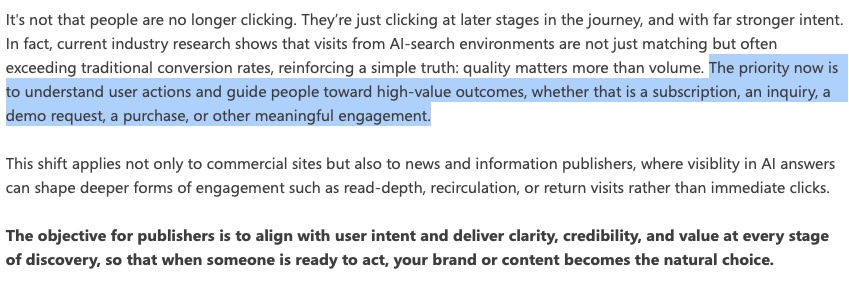
On the other hand, we know that in the age of AI, success is no longer measured solely in clicks, given that influence happens before the click. Visibility in summaries, comparisons, and AI responses is a form of value in itself. Although traffic may be lower, it arrives with higher intent.
Therefore, content quality not only helps with ranking but also with influencing the user.
We are certain that the debate over content quality will persist over time during the journey toward a search environment largely dominated by generative AIs. But even as these new environments change how content is offered or generated, ultimately, any LLM will value the quality and credibility of the content.
And there is no acronym or method that beats the most universal one of all: doing things right. Creating good content. Thinking about the user. Being the content and embodying the concepts.