Tabla de contenidos
What is a target audience?

A target audience is our primary market, that is, the potential consumers of our product or service.
When starting a business project, one of the first things to keep in mind is defining who our product or service is aimed at. Obviously, you could try to reach the entire public, but it is difficult to create a product or service that interests everyone.
To see this more clearly, here is an example: Laura is a 30-year-old hairdresser who has decided to open a hair salon. When Laura considers embarking on this business adventure, one of her first decisions is whether her clients will be women, men, or both. Laura has no experience cutting men’s hair, so she focuses on women. Within the group of women, there are various age ranges: girls, young adults, adults, and seniors. At this point, Laura decides that her innovative style is focused on young adults and adults. Once the age range is decided, it’s time to consider where to look for the premises. Laura, who is smart, decides to locate in a middle/upper-class neighborhood where the price of her services can be higher if she positions herself as the go-to hair salon in the neighborhood, where young women and their mothers go.
Types of customers
Once we have decided who our target audience is and have launched our business, we can divide our customers into several groups.
Advocates
These are the customers who are satisfied with the product or service and advertise it freely and spontaneously to their circle of acquaintances.
Decision-makers
These are the people with the power to decide whether to buy the product or service. Continuing with the previous example, if a 14-year-old girl wants a modern hairstyle, it will be her mother who finally accepts and pays for the service, so the mother is the decision-making customer.
Consumers
Consumers are the regular customers who consume the product or service habitually but do not necessarily have to be advocates.
Sociodemographic traits
Our target audience will be encompassed by specific sociodemographic traits. For example, a travel agency offering a trip to Disneyland Paris will have families with young children as their target audience.
In this way, we can define the user profile to get as close as possible to our end customer.
Defining target with Google AdWords
Until recently, Google offered us the Google Ad Planner tool to study the target audience of a website’s users. We obtained data such as gender, other websites visited, and the list of interests of the audience that had visited a specific site.
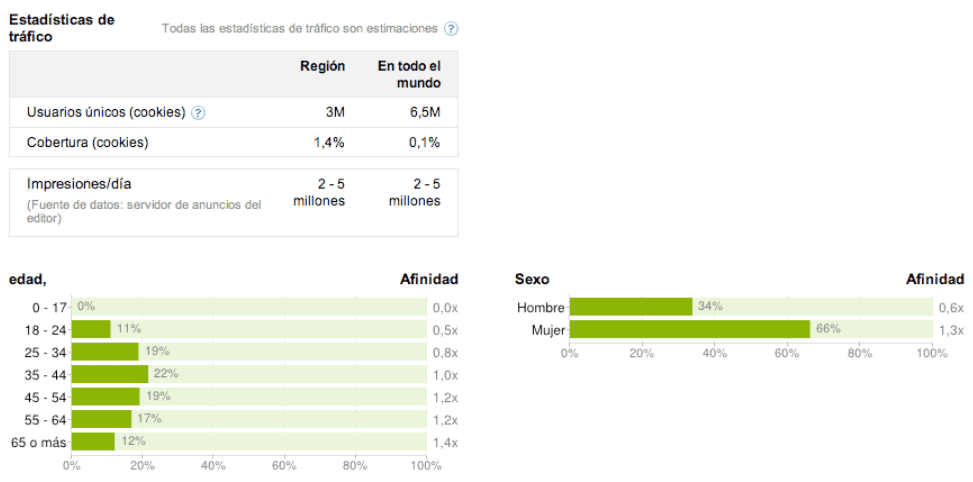
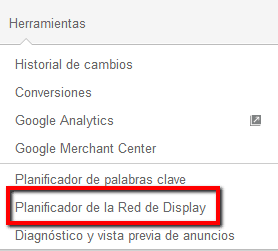
Now Google offers us some of these functionalities within Google AdWords, in what they call DoubleClick Ad Planner. We can find it within the Google AdWords tools, and to do so, we must select the “Display Planner” option in the main menu.
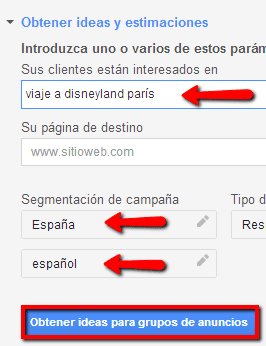
We can enter the terms our customers will use to search for the product or service we offer. For the travel agency example offering a trip to Disneyland Paris, and assuming that potential customers will use the search term “trip to Disneyland Paris,” we select the country from which the search will be performed and the language of the search.
The Google AdWords Display Planner gives us very useful information about the users who have performed these searches in recent months.
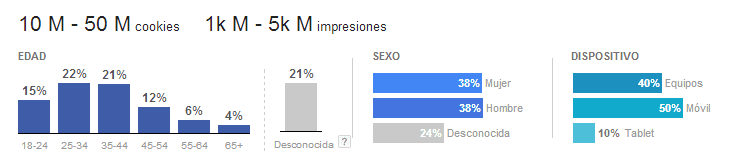
On one hand, we know that of 79% of the searches, 43% were performed by both men and women between 25 and 44 years old. This data fits the profile of parents with children. Regarding gender, we see that there is no predominant gender, so our target is composed of both women and men. Finally, this tool offers us a very interesting piece of information: the type of device from which the search was performed. In this case, 50% were performed from a mobile device.
This information is very useful for deciding how to get our product or service to our target audience. What are you waiting for to use it?