
Tabla de contenidos
It is the turn of Iñaki Huerta(@ikhuerta), from Ikaue.
SEO has changed: it is no longer crawling, authority and semantics.
Google’s change comes from Hummingbird, a new layer of interpretation of user search intent. This dates back to 2013 but more and more details have been added.
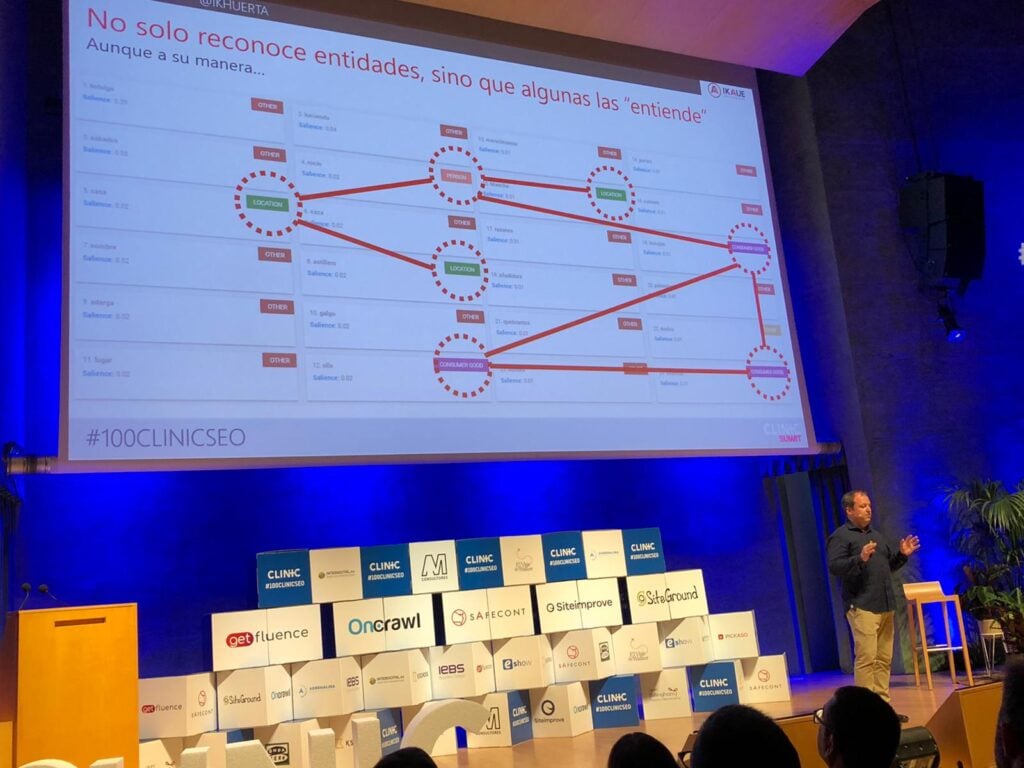
From a keyword, we have a search intent. The Google Brain team introduced artificial and voice search-oriented intelligence that interprets what is the real need behind a keyword. When we know the entities, everything is easier to understand. We can test Google’ s Natural Language API for free, it is accessible in the cloud.
Knowledge graph
From all this, Google develops the Knowledge graph: that box on the right where, based on entities, Google shows its recognition of entities and the relationships it recognizes between them. Thus, Google is able to “understand”.
Search intent
This is coupled with the search intent layer , which is what the user wants to solve. That’s why many websites suffer big hits: Google used to search for texts that matched a keyword, but not anymore. Google identifies the user’s real intention and looks for solutions to our problems. Before it found texts, now it finds solutions to our needs.
If we search for restaurants, Google knows that we want to go eat at a nearby restaurant. The search intentions are: to know, to do or to find. Positioning in each category is different.
For a “do” search, for example, the most important thing is to solve the problem: if the user wants to buy, the website has to sell. If it does not sell, it should not appear.
EAT
The expertise, authority and trust is the way Google resolves the quality of a text. Do not copy and paste, provide data, contrast, be referenced, do not differ from the rest… All this generates three types of processes:
- Beastlykeywords: I find the keywords.
- Decomposition into entities: I understand the content.
- Search intent: I detect whether or not the content will solve the user’s problem.
It will identify with different patterns whether a content satisfies the user or not: a good store with good content can rank well.
Does Google process everything in every search?
It does not process everything. Look for simpler KPIs that guarantee user satisfaction and cache through a search index. Some results are very successful and others do not work so well. What is certain is that the keyword is dead: Google focuses on search intent. Performing keyword research is becoming less and less necessary. Google already knows for which keywords a page has to be positioned.
We must change our mentality: we must think about the web and think about the product and the user.
It is necessary to work on semantics from the product: what does this product solve, what needs does it solve for the user, what contents respond to the search intentions and generate that specific content. This way we will already have the right content and we will only need to identify the exact keyword of that content.
This is how we work the search intent
- Know the company, the product and the business: understand what we are selling.
- Demographic analysis from companies such as Google Analytics. It often differs from the company’s own analysis.
- We analyze the website and understand the types of pages we have to play with: what are the assets we have. With a content categorization we can compare ourselves with large sites without problems.
- It is necessary to distinguish between real competition and aspirational competition: get in the way of who you play.
- Let’s benchmark to see what the competition does better than what we do.
- From here we generate SEO personas: what is important to you and we make the customer journey and the conversion funnel to classify the user among different types of SEO personas: primary, secondary, relevant or negative.
- Doing this work is time consuming but will serve us for many months.
- We make a map with all the search intentions and once we have this we will associate it to each type of content. This will lead us to reorganize the information architecture or create new content.
- The search intentions tell us the content needs, the funnel tells us the priority with which we should attack from the bottom to the top.
With Google starting to think like a user, let’s stop thinking in keywords and think like a user.