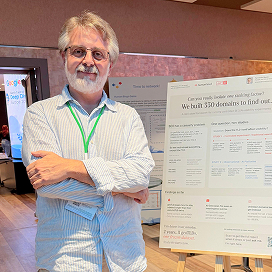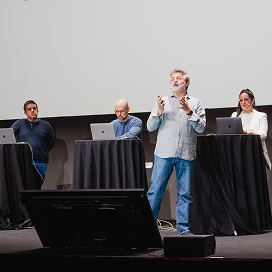
Our R&D Manager, José Emeterio Vicente, was a speaker at Innova Bilbao, a digital marketing conference on business creativity held on April 15, 16, and 17 at the Guggenheim Museum in Bilbao and organized by the newspaper El Correo.
The event brought together innovation experts from our country from fields as diverse as digital business, new technologies, economics, communication, the internet, and entrepreneurship.
A day full of talent
José took the stage on Friday, April 17, to present “The battle for findability: B2B SEO beyond Google,” sharing the stage with Mario Picazo, Koldo Saratxaga, Javier Sainz de los Terreros, Susana García, Inge Sáez, Lartaun de Azumendi, Ibon Landa, Joseba Etxebarria, Olga Llopis, Xosé Castro, Julieta Bolillo, Anita Álvarez Cufari, Fernando Únales, Nuria Agirre, Oihane Durán, Iñaki Parada, Eduardo Vázquez, Juanan Roncero, Roberto Carreras, Marina Hernández, and Elena Guerra.
The institutional welcome was led by Amaia Ruiz, Commercial Director of El Correo, along with Javier Garcinuño, General Director of Bilbao Ekintza; Susana Andrés Gorgojo, Director of Companies at LABORAL Kutxa; and Olatz Goitia, General Director of Beaz.
The battle for findability: B2B SEO beyond Google
In his presentation, José showed how the B2B purchasing process has changed radically. Previously, buyers would search on Google, visit websites, evaluate options, and contact a salesperson. Now, they ask ChatGPT directly, obtain a short list of recommended providers, and contact only those mentioned. If the AI doesn’t recommend you, you won’t even make it to the first call.
RAG: the technology behind AI answers
The presentation delved into the functioning of RAG (Retrieval-Augmented Generation), the technology that allows AI platforms to offer personalized and updated answers. RAG is evolving towards Agentic RAG, which is not satisfied with a single search. This system validates if the answers are sufficient, consults other sources, and cross-references data to respond with greater reliability.
This is where the concept of query fan-out comes into play: a single user question can internally trigger multiple specific micro-queries before returning the answer. For example, if someone asks about “collaborative robotics integrators for assembly lines in Bizkaia,” the AI might be simultaneously searching for ISO technical specifications, companies in the Basque Country, video demonstrations, and integration plans.
Being in the top 10 is no longer enough
José shared revealing data about where Google obtains content for its AI summaries. In July 2025, 76% of citations in AI Overviews came from the top 10 search results. In March 2026, only 38% came from the top 10. The remaining 62% is distributed among positions 11-100 and pages that are not even in the top 100. YouTube already represents 18% of mentions outside the top 100 and has grown 34% in six months. The conclusion is clear: it is no longer enough to be in the top 10 of the main search. Companies must become an authority on topics associated with their main entities.
The three layers of findability
José structured his strategy into three fundamental layers:
- The first layer is knowledge sources, where your company’s information truly lives: your website, catalogs, technical documentation, FAQs, blog, manuals, partner content.
- The second layer is decision engines, the AI systems that read, synthesize, and recommend, processing your information to generate personalized answers according to the user’s profile.
- The third layer is response surfaces, where the user receives the information: ChatGPT, Gemini, Perplexity, AI Overviews. What they all have in common is zero clicks. Findability is becoming the reliable source the AI turns to when it has to advise your clients, beyond just appearing on Google.
A five-pillar framework
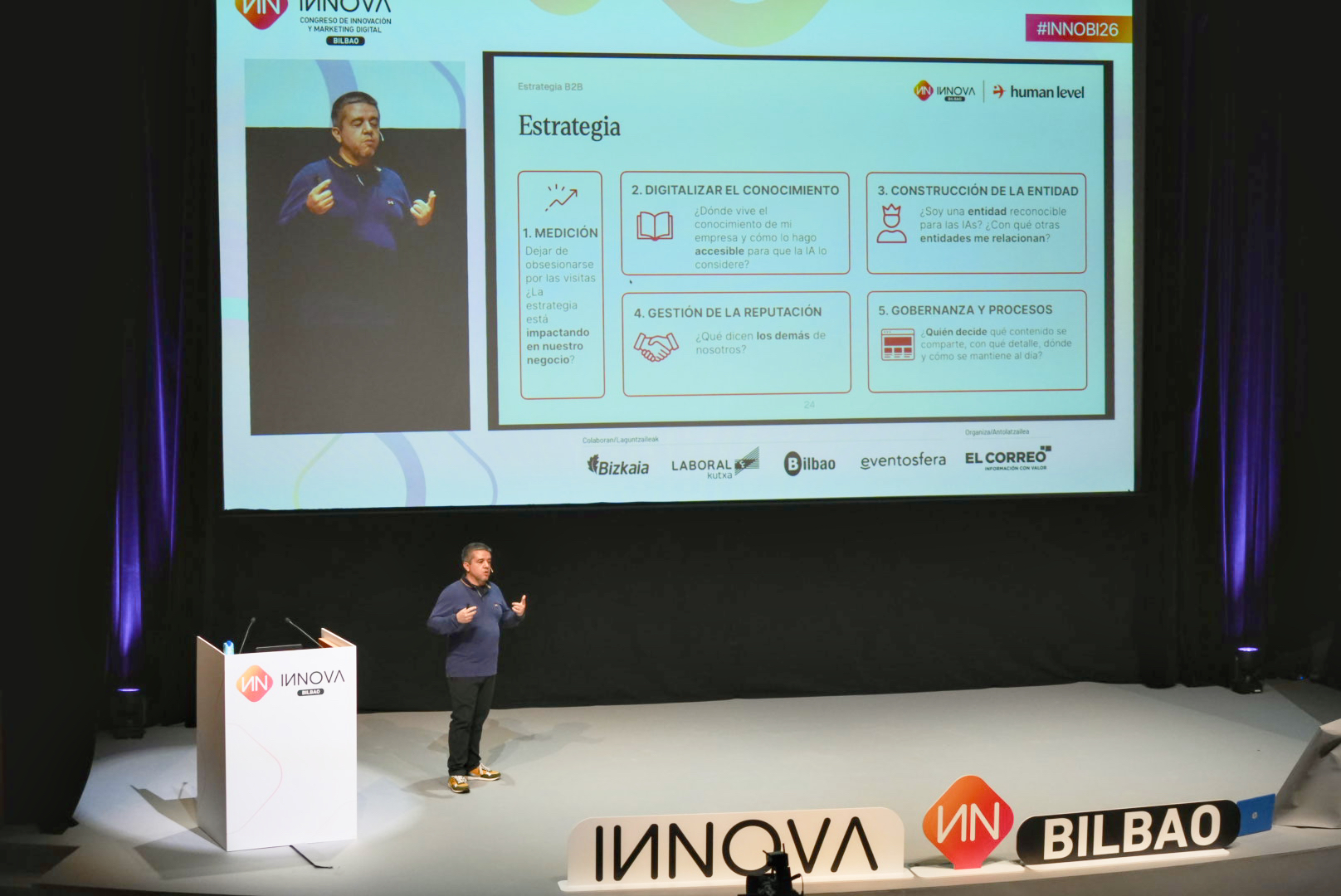
José presented a practical framework structured into five pillars. The first is measurement, stopping the obsession with visits to ask ourselves if we are cited in AI answers, what share of voice we have in LLMs, and whether we are rated positively. The key is not to obsess over specific prompts, but to focus on relevant topics. Findability starts with knowing your Searcher Personas, not keywords. José showed examples of multiple highly relevant profiles: the engineer looking for technical requirements to integrate a CNC milling machine, the sustainability manager comparing energy consumption, or the maintenance manager evaluating maintenance accessibility.
The second pillar is digitizing knowledge. AI cannot access what is not digitized, structured, and published. José proposed an audit of business knowledge to identify if it is in scattered PDFs, trade fair catalogs, or in the heads of senior employees. There is no direct relationship between content volume and visibility in AI; what is important is the depth of the published knowledge: technical guides, answers to the pain points of each Searcher Persona, best practices, and methodologies.
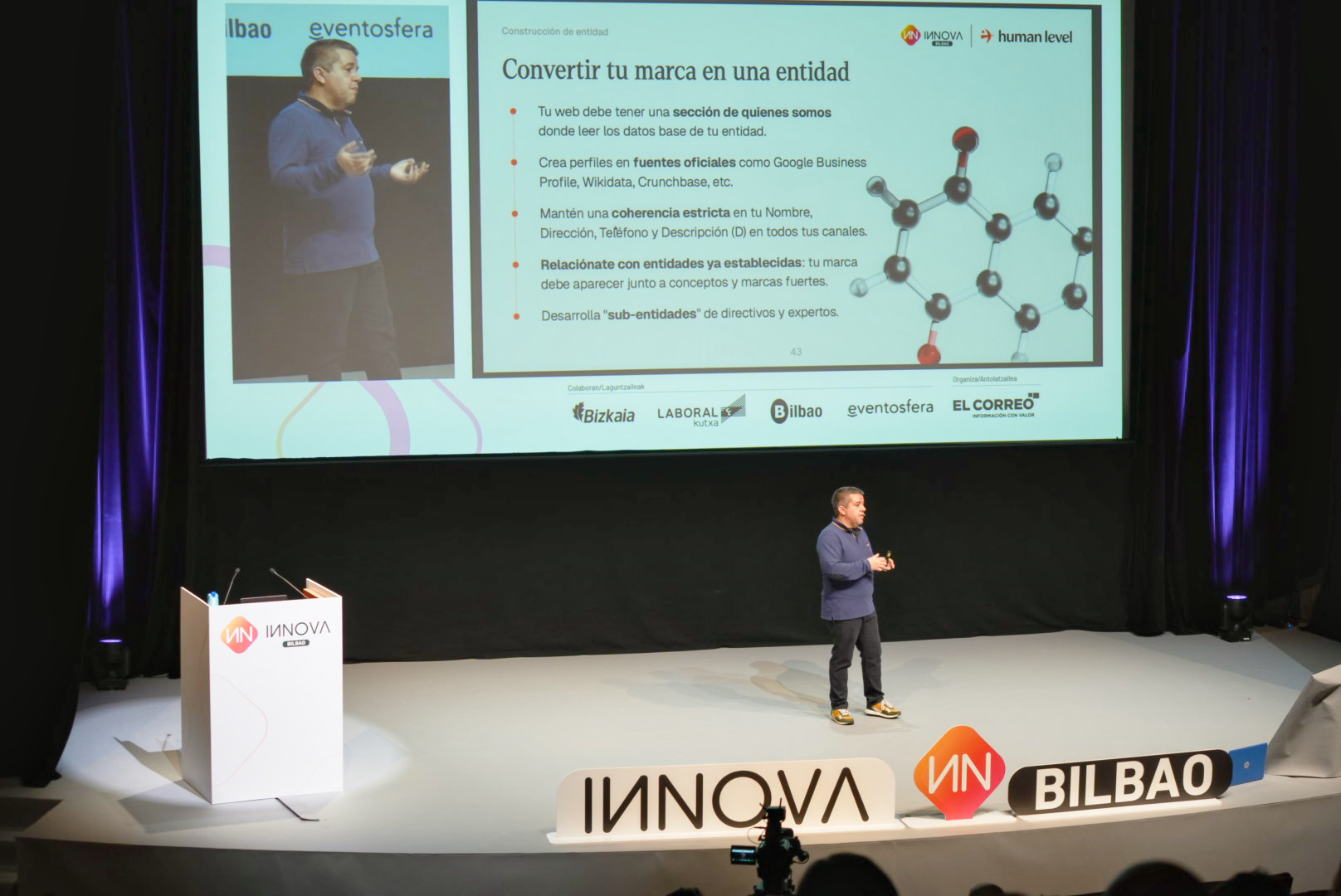
The third pillar is entity construction. Converting knowledge into AI-friendly assets requires transforming PDFs into HTML, implementing structured data, creating data tables instead of images, and checking that AI bots have access. It also implies converting your brand into a recognizable entity: maintaining strict coherence in name, address, phone number, and description across all channels, relating to already established entities, and developing sub-entities for executives and experts.
The fourth pillar is reputation. José shared a striking fact: only 9% of mentions in AI come directly from brand websites, while the remaining 91% comes from third-party content. Brands no longer depend solely on their own website; their success depends almost entirely on what others say about them. AI tends to recommend what it perceives as “sector consensus,” so presence in sector media, associations, technical publications, and customer testimonials gains capital importance.
The fifth pillar is governance and processes, addressing who approves what information is made public, with what level of technical detail, how it is kept updated, and what feedback the sales and customer service team provides.
At the forefront of findability
Human Level’s participation in Innova Bilbao reinforces our approach to visibility architecture. We are not limited to conventional SEO; we develop proprietary methodologies that integrate the analysis of Searcher Personas with Digital PR strategies to build an authority that influences decision-makers wherever they choose to look.
With more than 20 years of experience anticipating changes in the digital ecosystem, at Human Level we help companies convert these technological challenges into measurable competitive advantages.