
Tabla de contenidos
- Google continues to dominate, but AI adds a new layer
- The new short list: from Google to LLMs
- SEO was won inside, findability is won outside
- How AI Works: triangulation and query fan-out
- Building presence for AI: three layers
- Digital PR: the objective has changed
- The Four CMO Decisions
- Real Cases: Santander and Philips Hue
- Semantic consensus, not manipulation
- Building authority where AI consults
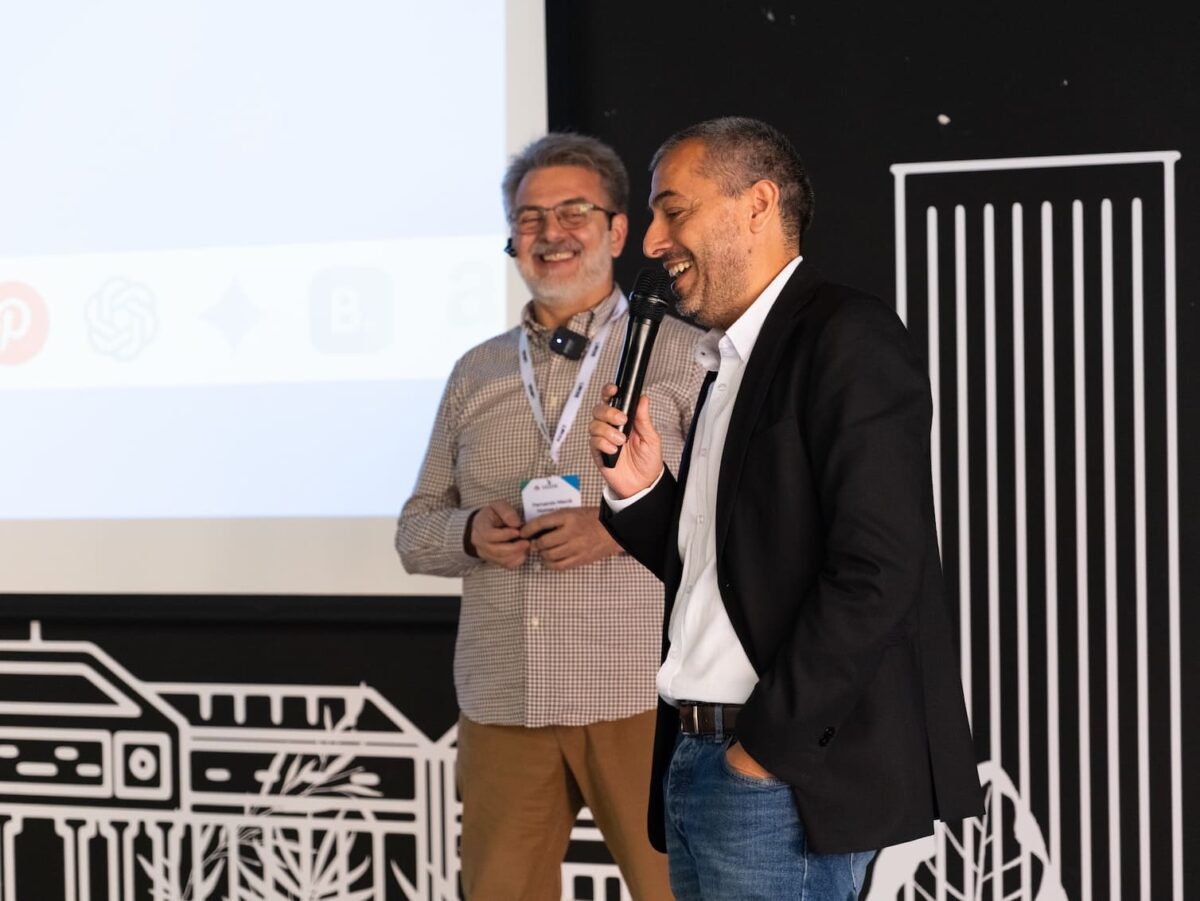
On May 19, our director Fernando Maciá participated as a speaker at MIDE Summit 2026, an event organized by MIDE at Talent Garden Madrid that brought together industry experts to share how the emergence of AI chatbots is completely transforming the way people search, discover, and consume information.
The welcome was led by Asier Barainca, senior digital analytics consultant at LIN3S, and Ana Belén Leiño, SEO Project Manager at LIN3S. Also taking the stage were Natzir Turrado, Gianella Ligato, and David Villarrubia.
Fernando presented “Semantic Consensus: How to Build Your Brand Authority Beyond Your Website”, a presentation that addressed one of the most profound changes taking place in digital marketing: building brand authority in the era of generative search.
Google continues to dominate, but AI adds a new layer
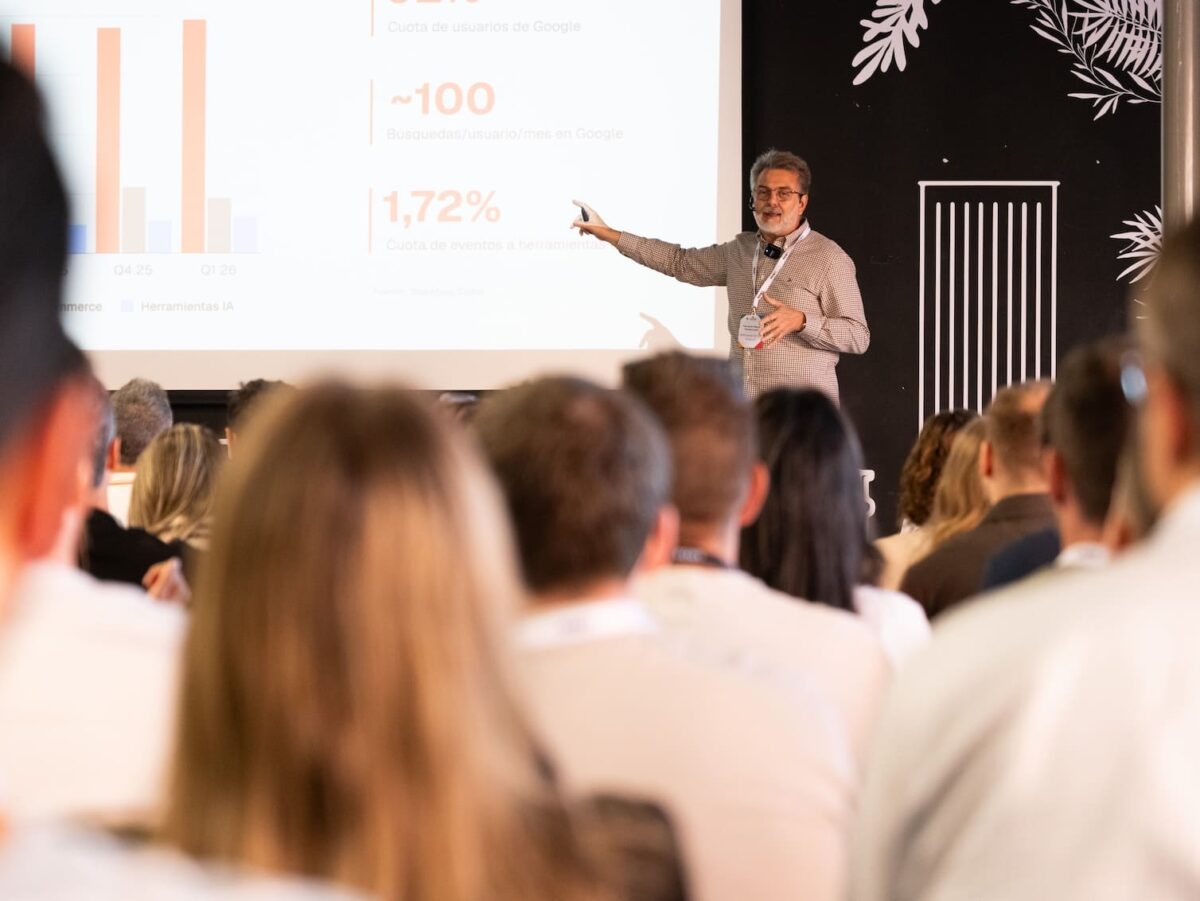
Fernando began his presentation by debunking the myth that AI will replace Google. Sparktoro data shows that Google maintains a 92% user share and approximately 100 searches per user per month. AI tools currently represent only 1.72% of search events. AI adds, it does not replace.
However, users prefer AI tools especially in the initial phases of their purchase decision process, while traditional search engines gain an advantage in comparing options and final selection. This radically changes how brands must approach their visibility strategy.
The new short list: from Google to LLMs
Fernando explained how the user decision process has evolved. Previously, the brand short list was built through multiple channels: website, blogs, advertising, reviews, social media, media, analysis, and word of mouth. Now, LLMs act as intermediaries that consult all those sources and generate a short list of options.
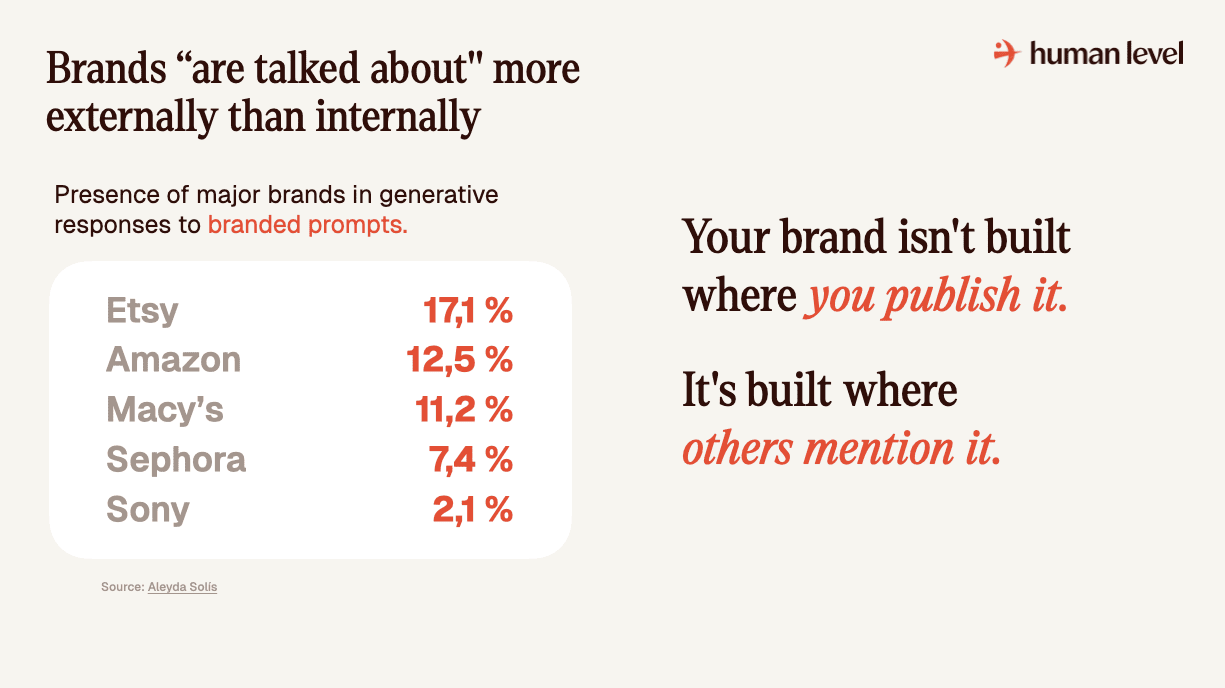
The major difference is that 84% of citations in AI responses come from earned media, not from the brand’s website. This means your brand is no longer built only where you publish it, but also where others mention it.
SEO was won inside, findability is won outside
One of the key ideas Fernando wanted to convey is that, while traditional SEO was essentially won by optimizing within the website (topical, semantic, and technical authority), findability in AI is won outside. 91% of mentions in AI come from third-party content, not from the brand’s website.
Fernando shared revealing data about major brands. For example, in branded searches (branded prompts), Etsy appears in only 17.1% of generative responses, Amazon in 12.5%, Macy’s in 11.2%, Sephora in 7.4%, and Sony in just 2.1%. Even major brands face an enormous challenge ahead.
How AI Works: triangulation and query fan-out
The presentation delved into key technical aspects. Fernando explained that 88.6% of queries to ChatGPT generate exactly two internal sub-queries. AI does not settle for searching just once: it divides the problem, searches from multiple angles, and then cross-references results. This means that we are not competing for a keyword, but for all the angles from which our category can be queried.
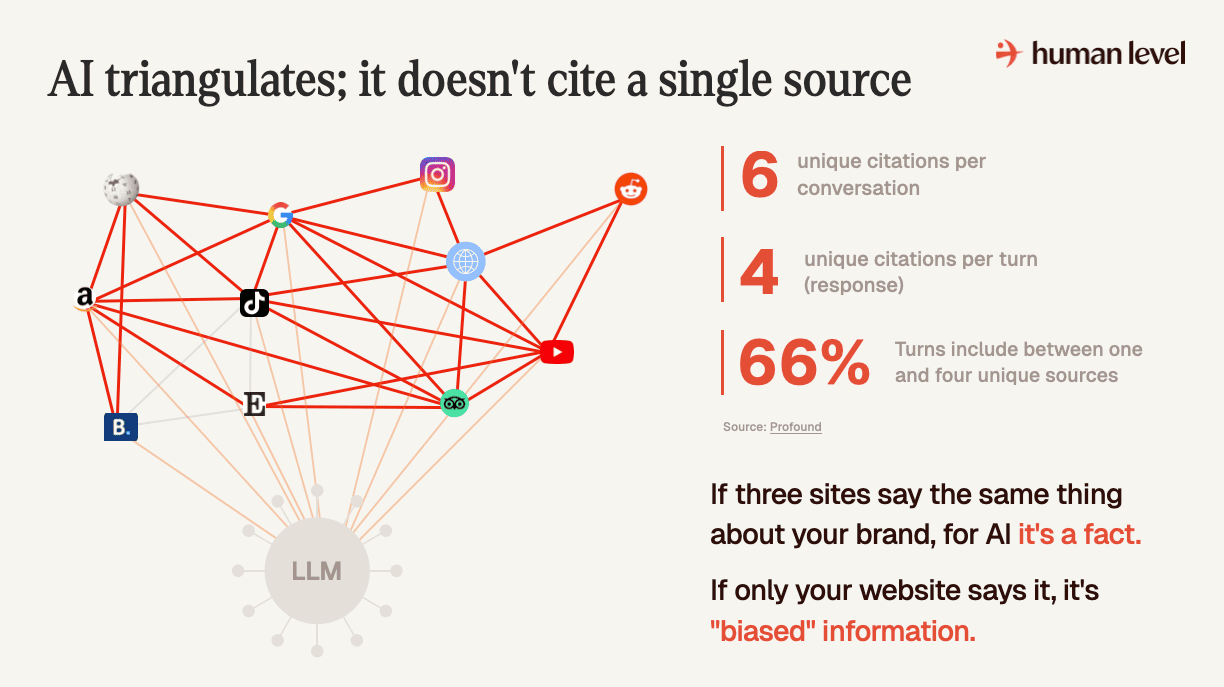
Additionally, AI triangulates information from multiple sources. On average, each conversation includes 6 unique citations, with 4 citations per response. 66% of turns include between one and four unique sources. If three sites say the same thing about your brand, for AI it is a fact. If only your website says it, it is “biased” information.
Another important finding: the sources cited by AI vary constantly (only 2.37% of URLs appear in the three models analyzed), but the recommended brands coincide 35-55% regardless of the sources cited.
Building presence for AI: three layers
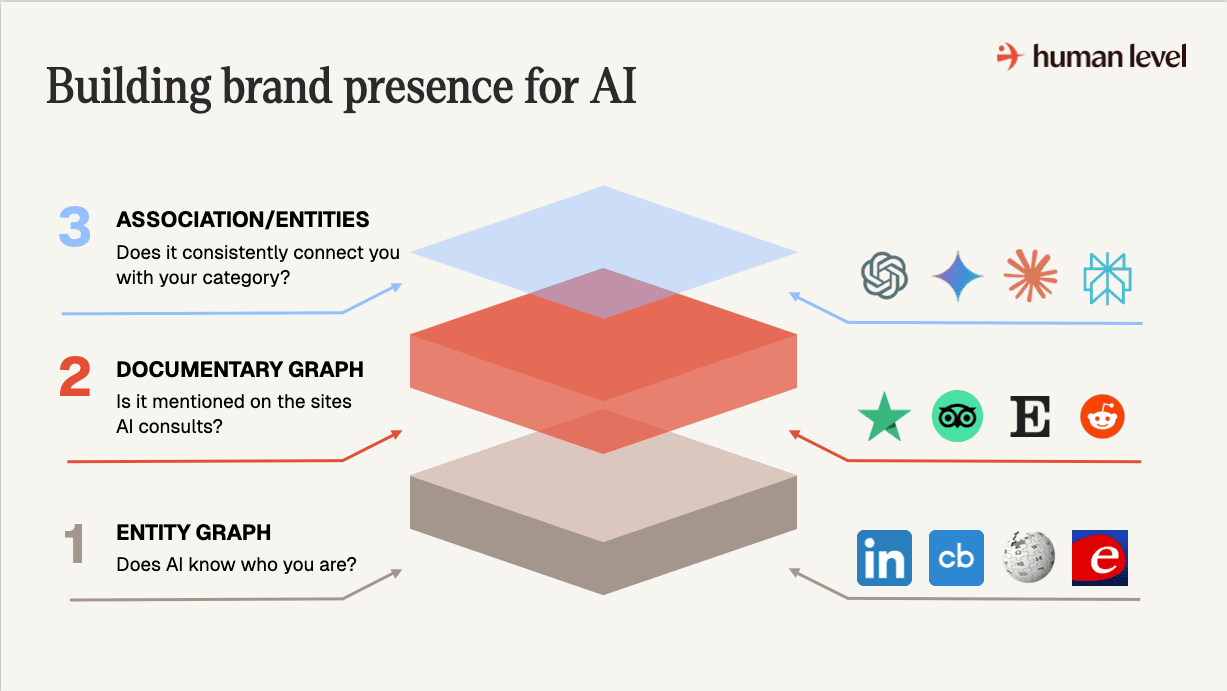
Fernando broke down the strategy into three levels:
1. Entity Graph: Does AI know what you are? Requires presence in sources such as LinkedIn, Crunchbase, Wikipedia, and other structured knowledge bases.
2. Document Graph: Are you being discussed on the sites AI consults? Includes media outlets, Reddit, TripAdvisor, and authoritative sources in your sector.
3. Association and Entities: Does it consistently connect you with your category? Different AI models (ChatGPT, Gemini, Perplexity, Claude) must associate your brand with the problems you solve.
Digital PR: the objective has changed
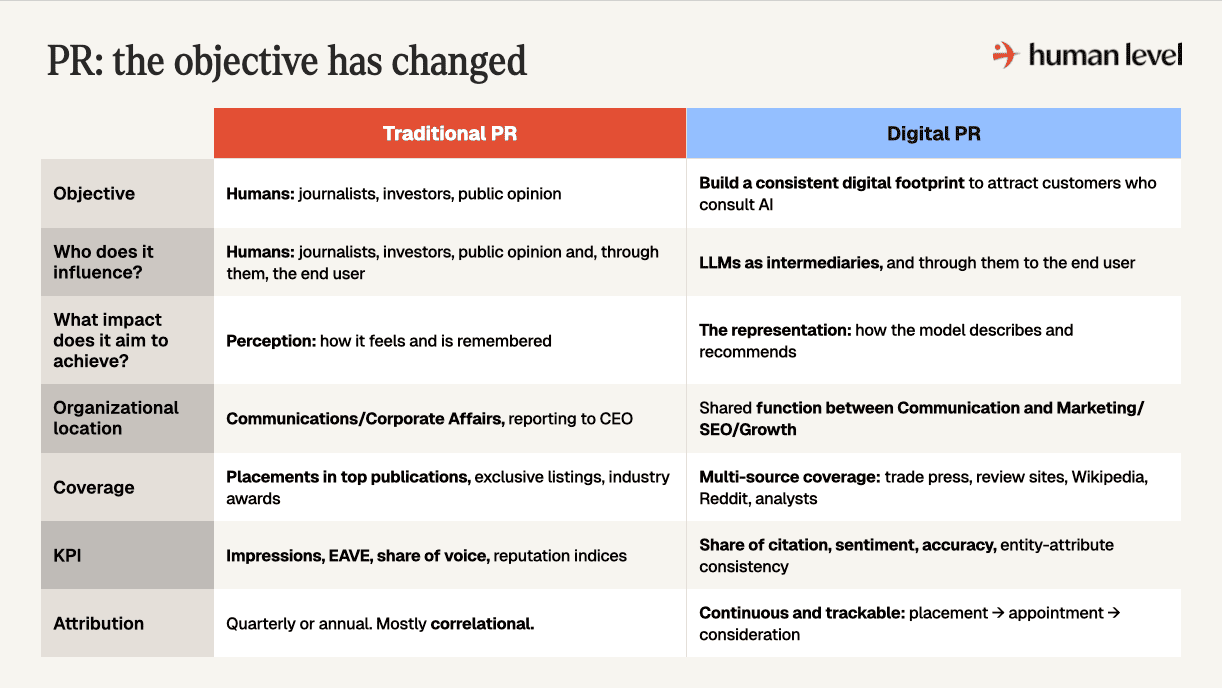
Fernando dedicated a significant portion of his presentation to explaining how Digital PR must evolve. While traditional PR sought to build corporate reputation by influencing journalists and investors, current Digital PR must build a coherent digital footprint to attract customers who consult AI, influencing LLMs as intermediaries.
The impact is now both perception (how the brand is felt and remembered) and representation: how the model describes and recommends your brand. KPIs shift from impressions and share of voice to share of citation, sentiment, accuracy, and entity-attribute consistency.
And the speed is remarkable. Content in earned media can be cited by Perplexity in 1 to 7 days, by ChatGPT with web search in 3 to 14 days, by Bing Copilot in 7 to 14 days, and by Google AI Overviews in 1 to 3 weeks.
The Four CMO Decisions
Fernando closed his presentation with a practical four-step framework:
1. Define Target Entities: Create a map of categories, attributes, and contexts with which you aspire for AI to relate your brand.
2. Audit Your Current Citation Graph: Document which brands and sources are appearing for your critical prompts in each model.
3. Align Your Communication and Digital PR: Identify your institutional communication, commercial content, and user-generated content. All three must be aligned.
4. Change Your KPIs: Success indicators must be share of citation, sentiment, and response accuracy, not just impressions or visits.
Real Cases: Santander and Philips Hue
The presentation included concrete examples. In the case of Santander, Fernando showed the URLs with the most citations in AI responses, where, in addition to its own domain, sites such as Rastreator, Finect, Economía Responsable, Banco de España, and HelpMyCash appeared. In the case of Philips Hue, the most cited sources that were not from the company itself were TechRadar, Tom’s Guide, PCWorld, Wired, and T3.
These examples demonstrate that brands need to be present on the sites that AI consults as authoritative sources, not just on their own website.
Semantic consensus, not manipulation
Fernando was clear in differentiating communication alignment from LLM poisoning. It should not be confused with manipulating AI by injecting false content. It is positioning your brand for what it is, coordinating truthful messages through semantic consensus across channels as a sustainable brand strategy that is reinforced with each honest review.
Human Level’s participation in MIDE Summit reaffirms our approach: in a world where 84% of citations in AI come from third parties, brand authority is built outside your website. We combine over 20 years of SEO experience with Digital PR strategies to help companies be findable wherever their customers search, whether on Google, ChatGPT, or Perplexity.