
Tabla de contenidos
Companies invest heavily in defining who they are. Years of work go into articulating a value proposition, a tone of voice, and key messages. Dozens of meetings are held to agree on which adjectives belong on the website and which do not. All that effort makes sense, of course. But there is one question that almost no one asks at the end of the process: how do others see us? I’m not talking about Google reviews or social media comments. I’m referring to the narrative that the media builds about your sector, the response generated by AI when someone asks about companies like yours, or when someone searches for a solution to a problem you solve—the image a journalist forms before deciding whether or not to call you. That perception exists, it is constantly updated, and in most cases, no one within the company knows exactly what it is.
At Human Level, we have been analyzing brand self-perception and external perception, and the context behind them is quite revealing. This is what we are going to explore in this article.
The Gap No One Measures
Think of a tech firm that has pivoted its strategy toward sustainability, integrating it into its processes and reports with Environmental, Social, and Governance (ESG) criteria. Internally, the message is omnipresent. However, when auditing its digital footprint, we discover that 90% of its media coverage remains anchored in funding rounds or executive changes. To the outside world—and to the data feeding search engines—that commitment to sustainability simply does not exist.
The same thing happens with companies that perceive themselves as “innovative” or “disruptive,” while the trail they leave in specialized media labels them as “veterans” or “traditional.” Two parallel narratives that never touch.
This gap between self-perception and external perception is not a one-off communication failure or the result of a poorly written press release. It is a structural, silent, and very common problem. Companies usually know very well what they want to communicate, but they rarely know if what they communicate has sunk in, how it has sunk in, and what shape it has taken when landing in the outside world.
The Three Layers of How You Are Seen
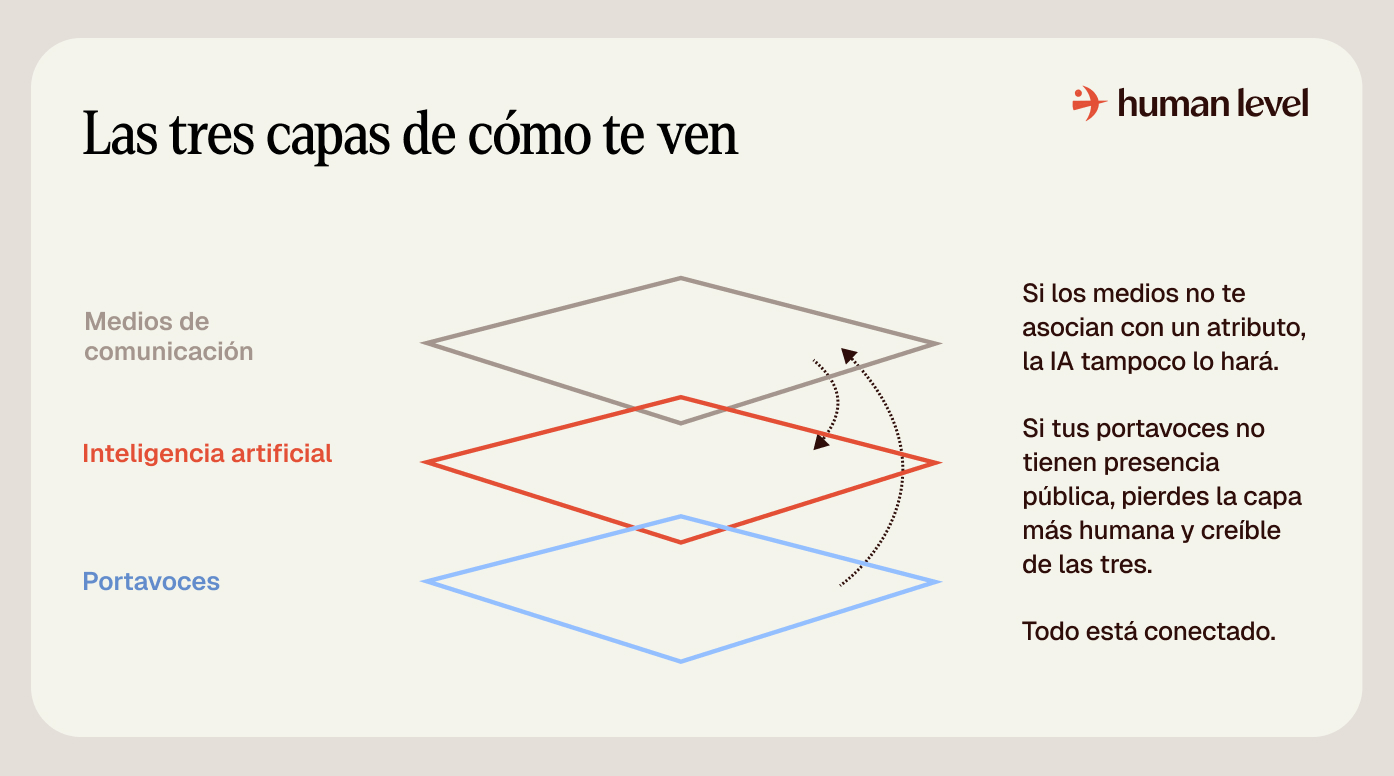
Brand perception today is built on three different levels that few companies analyze together.
- The first is the media. What they publish about you, how often, in what context, and whether they mention you as an expert source or just another name on a list. The media remains the most influential layer because its content feeds the other two; hence the importance of Digital PR.
- The second is artificial intelligence. When someone asks ChatGPT, Gemini, or Perplexity about your company or your sector, the answer doesn’t just come from your website. It comes from what others have written about you: articles, interviews, studies, and specialized forums. If those external sources are scarce, outdated, or repeat only part of your story, the AI offers an incomplete version of who you are. And that incomplete version is what reaches the user at the exact moment they are making a decision.
- The third is spokespeople. The visible face of a company—its CEO, its executives, its reference experts—carries enormous weight in how the brand is perceived from the outside. An active spokesperson, who appears in the media and generates their own content, amplifies all of the company’s messages. An invisible one weakens them, even if the company considers them a key person internally.
These three layers do not function independently. If the media does not associate you with an attribute, neither will the AI. If your spokespeople have no public presence, you lose the most human and credible layer of the three. Everything is connected.
The Risks of Misalignment
Ignoring this gap has direct commercial consequences. A journalist researching the company before an interview who finds a narrative that contradicts the official discourse will lose interest or change the angle to a less favorable one. A potential client who consults an AI answer engine about “leading solutions in the sector” and does not find your brand because your differentiating attributes have no external backing is a lost sale before it even begins.
Even talent acquisition is affected. The professional you are looking for to fill key positions does not stay on the surface of your website; they track what is being said about you in the market. If there is a break between your declared values and your digital reality, credibility suffers. The invisible friction generated by a misaligned external perception is one of the greatest obstacles to organic growth.

What Data Reveals When You Look at Yourself from the Outside
When this analysis is done rigorously, the patterns that emerge are surprisingly consistent across sectors and company sizes. Brands are usually further ahead in their internal discourse than their external presence reflects. A company may have spent years working on its positioning as a leader in artificial intelligence, integrated it into its services, and published about it regularly, but if no media outlet has picked up that work, the AI doesn’t know about it either. The effort exists, but it has not left the company’s own ecosystem.
The most repeated messages in self-perception are not always the ones that have the most impact outside. Sometimes a company builds its entire identity around a concept, uses it in every presentation, and puts it on the homepage of its website, but no one on the outside has adopted it. Not because it is a bad message, but because there has never been a strategy to transfer it to the external narrative with consistency.
And then there is the most valuable finding of all: external coverage sometimes highlights attributes that the brand itself has never claimed as its own. A pedagogical approach that the media perceives but the company does not communicate. An international capability that appears in articles but not on the home page. A way of working closely with the client that journalists mention and that the company takes for granted. There are huge opportunities there that are lost by not looking outward carefully.
In our experience, we came across a company that was a pioneer in inventing the product that today defines its category, but it did not use this fact as an asset or differential advantage in its communications. Therefore, no media or AI picked it up because they themselves had never turned it into an argument. A lost opportunity.
Something similar happens with spokespeople. In some cases, we have found that an executive’s personal profile accumulates many more followers than the brand’s official channel in that same market. A clear sign that the audience wants to hear from people, not just the company, and that this human asset is underutilized in the communication strategy.

Strategies to Close the Gap
It doesn’t take a months-long project to start understanding how you are seen. There are some concrete actions that any company can put in place:
- The first is to ask AI in incognito mode. Open a new session, without history, and ask ChatGPT and Gemini about your company and your sector. Note the attributes they mention, those they don’t, and the companies they do name. Although LLM responses vary greatly, you can repeat the exercise with different models or by trying different prompts and see where they coincide.
- The second is to audit media coverage from the last year. It’s not about counting mentions, but about analyzing the context: in what topics do you appear? As an expert source or as a secondary data point? What attributes do the media outlets that interest you most associate with you?
- The third is to review the visibility of your spokespeople. When was the last time the CEO or the director of your reference area appeared in a medium relevant to your audience? Do they have an active presence on LinkedIn or just an account with a profile picture? An invisible spokesperson is a positioning opportunity wasted every day.
- And the fourth is attribute transfer. Identify which internal values lack external backing and design a Digital PR strategy and content that generates the necessary “evidence” for third parties (and AIs) to pick them up.
Consistency between who you are, what you communicate, and what others say about you is not a luxury reserved for large companies. It is a competitive necessity for any organization that wants to control its narrative in an environment where AI increasingly mediates between companies and their potential audiences.
The first step to leading your sector is not deciding what you want to say, but knowing what story is being told about you right now. If you want to know how the media and AI see you, at Human Level we can help you perform this analysis and outline strategic actions to help your brand.