Tabla de contenidos
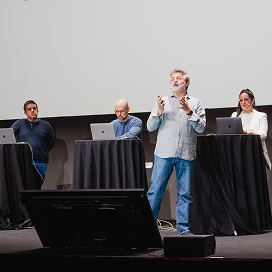
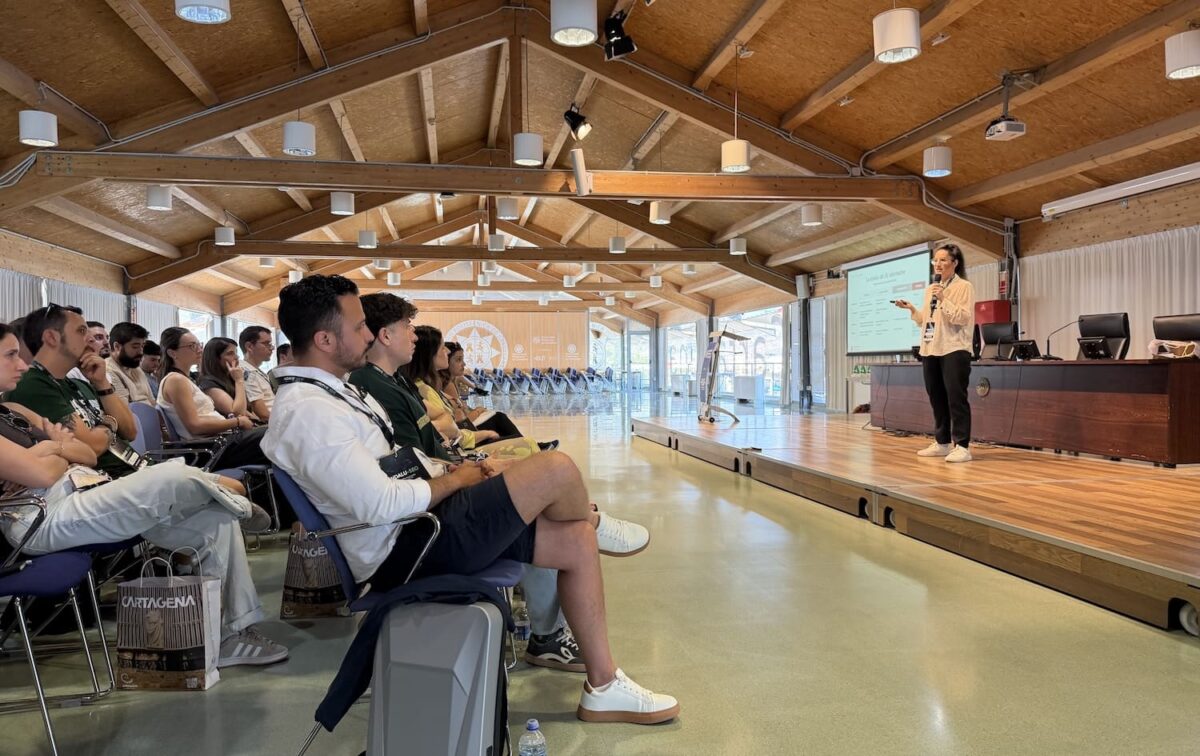
María Navarro, our Head of SEO at Human Level, participated as a speaker on May 30 at Andalu-SEO, an event held in Cartagena that brought together industry professionals to debate how the new search ecosystem is redefining the way brands build and measure their online visibility.
The event was presented by Carlos Sánchez, Ana Mata, and Sergio Somoza. Also appearing as speakers were Martin Splitt, Lorena Romero, Juan González Villa, Carlos Pulido, Violeta Delgado, Javier Bermúdez, David Carrasco, Natalia Witczyk, and Laura Castilla.
María presented “Brand Health in 2026: Diagnosis Beyond Ranking and Clicks”, a presentation that addressed one of the most disconcerting symptoms many companies are experiencing today: interest in their brand is growing, their Google rankings are holding steady, but traffic is falling. What is happening?
If interest changes, the business changes
María started with a distinction that seems simple but changes everything. When interest in a brand grows, demand exists, purchase intent increases, and there is a foundation for conversion to grow. When interest falls, the problem is not always SEO: it could be brand, product, or market-related. Confusing both scenarios leads to applying the wrong solutions.
The real problem, however, appears in a third scenario: when interest rises and visibility remains, but the click does not arrive. And that is precisely the scenario that defines 2026.
Brand traffic is no longer proportional to interest
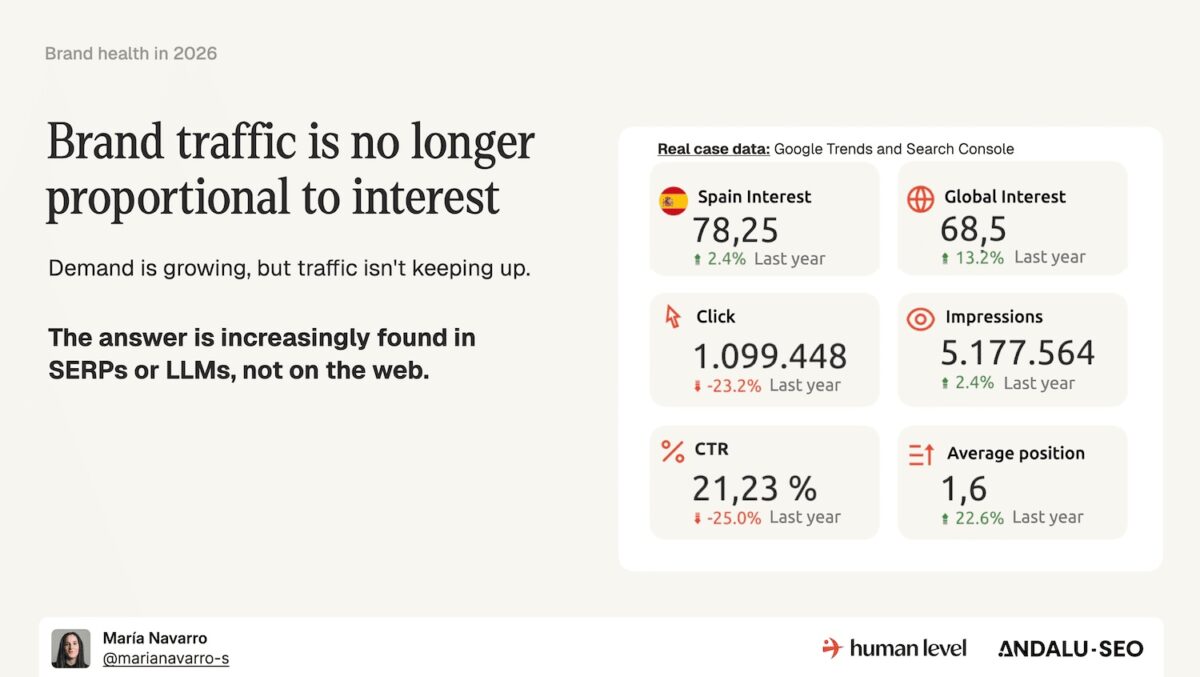
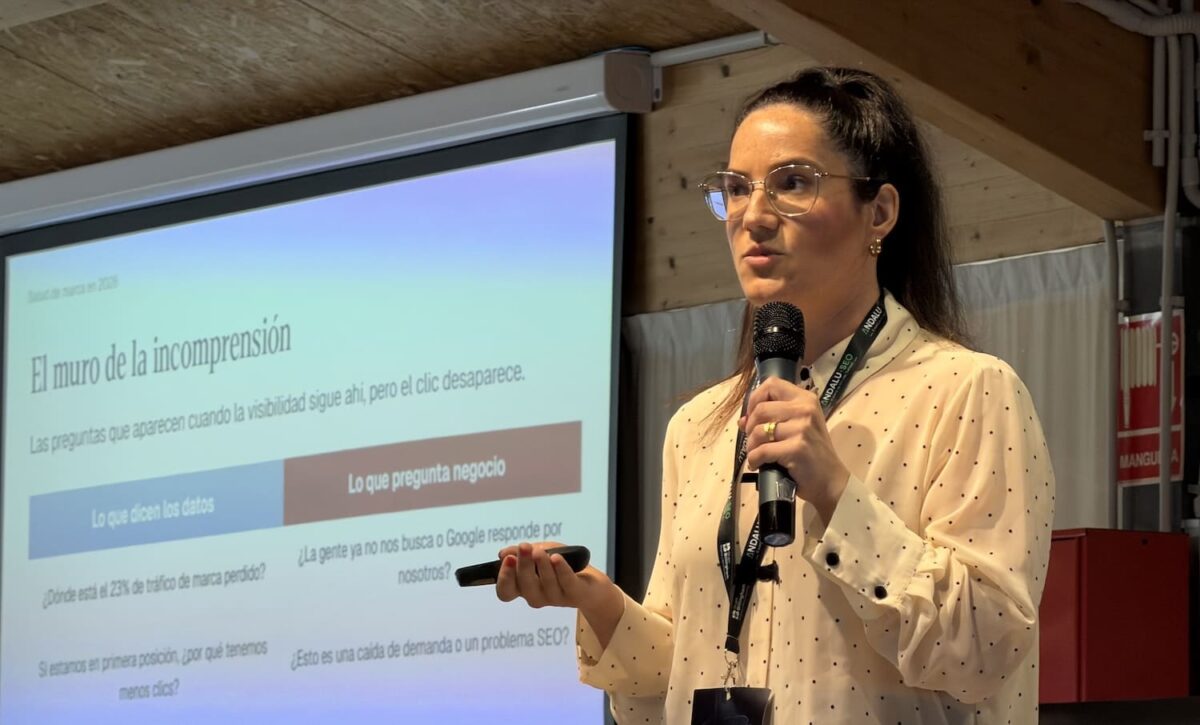
To illustrate this, María showed real data from a client: brand interest in Spain had grown by 2.4% compared to the previous year, and global interest by 13.2%. Impressions were up 2.4% and the average position had improved considerably. However, clicks fell by 23.2% and the click-through rate by 25%. The demand existed. The positioning did too. The user, quite simply, was not reaching the website.
The explanation is structural: search engines and AI assistants are resolving more and more queries directly on the results page or within the conversation itself, without the user needing to click. The brand makes an impact on the mind, but leaves no trace in the analytics.
The click disappears from the buyer journey
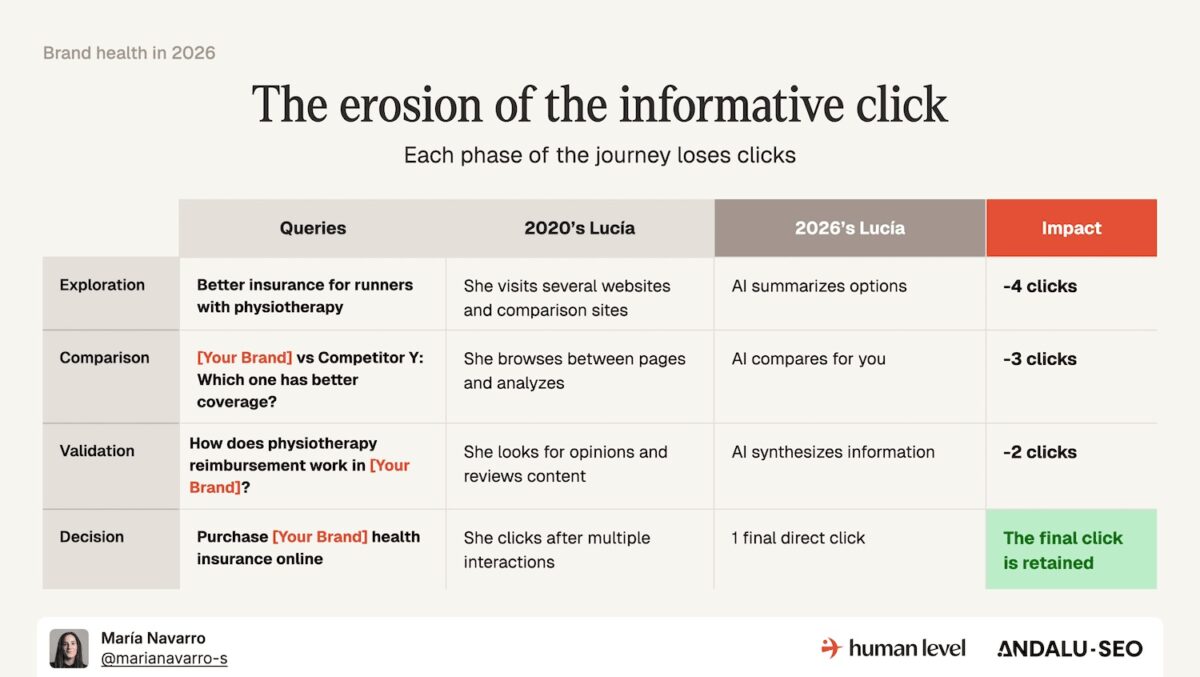
María compared the behavior of the same user profile in 2020 and 2026. The 2020 user visited several websites to explore options, browsed between pages to compare, looked for reviews to validate their decision, and ended up clicking after multiple interactions. The 2026 user follows that same path, but AI summarizes, compares, and synthesizes for them. The final purchase click remains, but all intermediate clicks have disappeared. Every phase of the decision-making process loses clicks, except for the last one.
The direct consequence is that many brands interpret this drop in traffic as an SEO failure when, in reality, it is a sign that AI has absorbed the exploration phase. The challenge is not to disappear from the results: it is to become the answer that the model chooses.
From measuring clicks to measuring influence
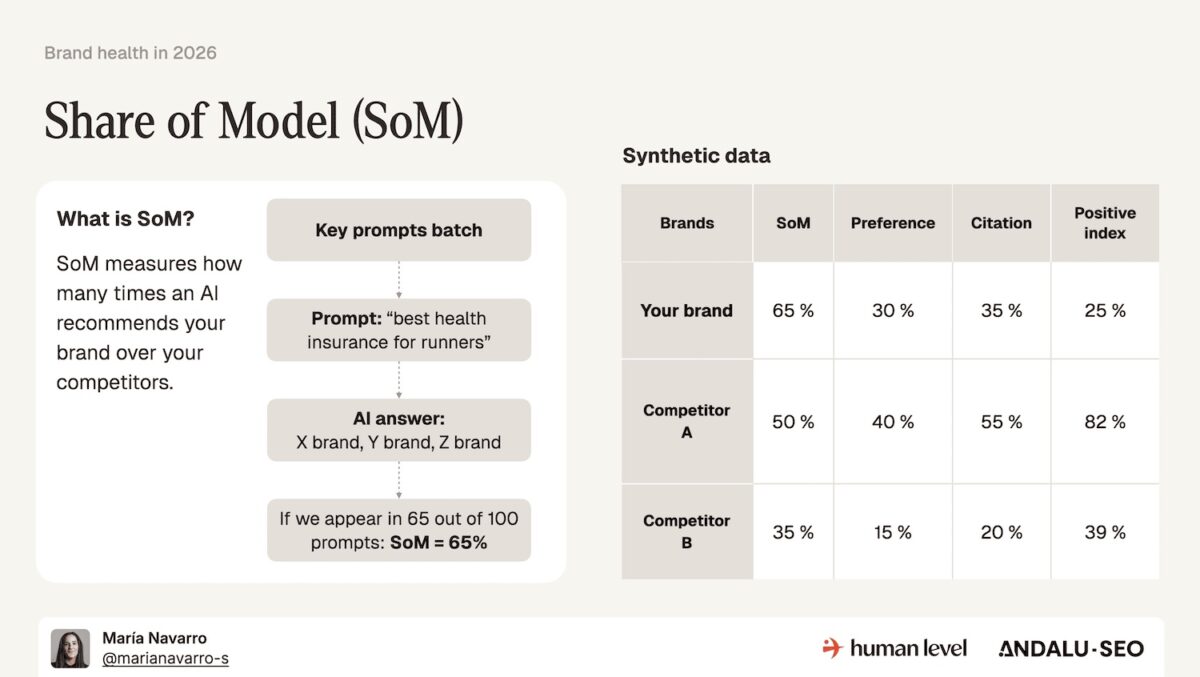
Faced with this new scenario, María proposed expanding the metrics dashboard. Traditional SEO still mattered, with indicators such as impressions, top 3 presence, and average position, but it was insufficient. It was necessary to incorporate influence metrics: the percentage of times the AI mentions the brand versus competitors for the same question (the so-called Share of Model or SoM), brand citations in generative responses, the sentiment with which the AI describes the brand, and sessions arriving from AI tools.
María was clear about the limitations of this measurement: model responses are not deterministic, the volume of prompts required is high, specialized tools have a cost, and results should be interpreted as trends, not absolute values. Even so, it is possible to measure relative presence against competitors and guide strategy based on that data.
Authority is no longer built only from within
One of the central ideas of the presentation was that traditional SEO is not dead, but has evolved to also become the backbone of AI. Without organic visibility and technical authority, a brand does not exist for language models. But that internal foundation is no longer enough.
For AI to recommend a brand, it needs to be present in the ecosystem that the AI consults: specialized media, comparison sites, forums, and communities. Contextual repetition in these sources is what builds authority. In María’s words, what Google uses to trust, AI uses to recommend.
The questions we cannot stop asking ourselves
María closed her intervention with five questions that any marketing team should be asking themselves right now: whether brand demand is growing, whether clicks are being lost despite maintaining positions, whether the composition of search results has changed, whether indirect competition has increased, and whether only results are being measured or influence as well. And with a reflection that serves as a guide: just as television, radio, and outdoor advertising never had perfect attribution and yet built memorable brands, in 2026, we don’t just measure attribution. We measure influence. Not every impact results in a click, but it does leave a mark on the decision.
That mark is precisely what we work on at Human Level. If your data shows that interest in your brand is growing but traffic is not following suit, the problem probably isn’t on your website. It’s in how you are represented in the digital ecosystem where AI learns. We combine over 20 years of SEO experience with Digital PR strategies to help you diagnose the problem and build the presence your brand needs to be the chosen answer.
If you want to see María’s full presentation, it is available here.