
Tabla de contenidos
For years, measuring brand sentiment meant reviewing social media comments and marketplace reviews, plus traditional press clipping. Today, however, the most relevant conversation about your company happens elsewhere: in the responses language models give when someone asks about your industry. And what they say is already influencing user purchase decisions before they even reach your website.
Brand sentiment has a new dimension
The concept of sentiment has been in the PR playbook for decades, but how it’s measured now has completely changed. The classic question was whether you were mentioned in a positive, negative, or neutral tone. The current question, however, goes a step further: what attributes are being used to describe you and from which sources did those attributes come.
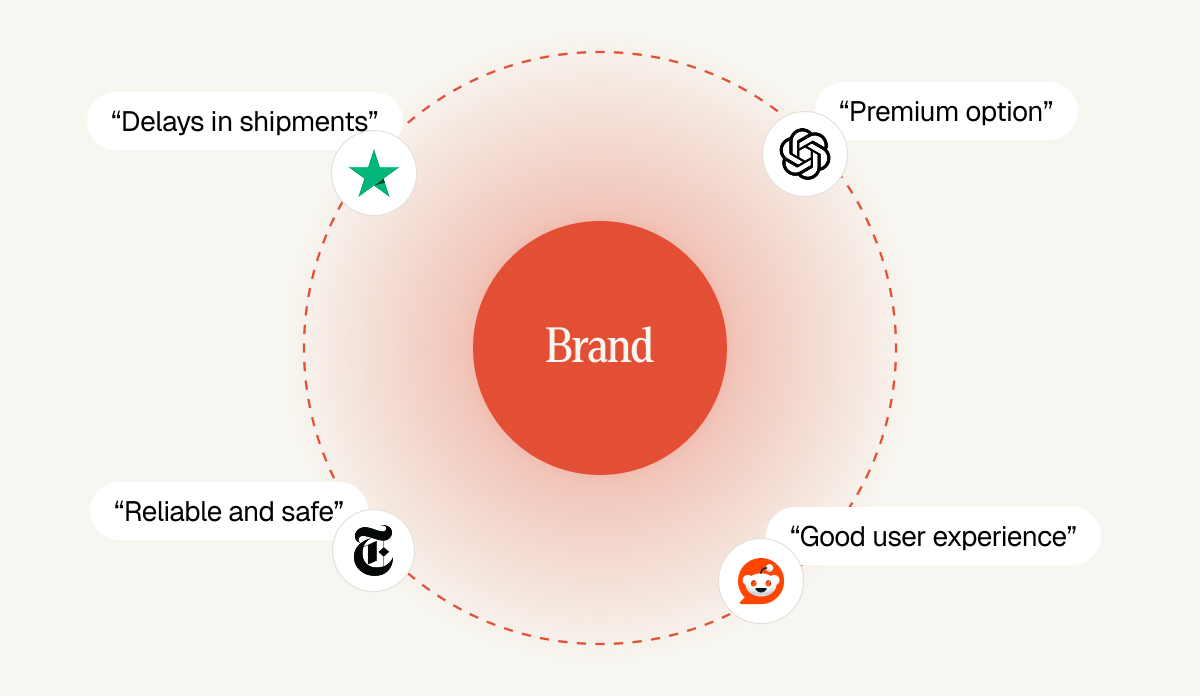
When a language model describes your brand, it returns a network of characteristics woven from the texts it read during training and from the sources it consults in real time—what’s known as semantic consensus. That semantic consensus can be audited and, above all, modified. Classic sentiment analysis now coexists with attribute analysis, which is what drives purchase decisions in an ecosystem where users arrive at the brand with an opinion already formed by AI.
Where brand sentiment is formed today
The environments where a company’s perception is built have multiplied. Social media, reviews, and traditional media clipping have been joined by four fronts that any PR strategy should be auditing: news media with editorial weight that train language models, generative AI platforms, search results, and user communities like Reddit or specialized forums.
Each of these environments amplifies sentiment in a different way and requires its own measurement approach. A critical comment in a Reddit thread with many interactions can end up weighing more in an AI model’s response than a positive mention in a tier 1 outlet, because data agreements signed between different companies, like the one between Google and Reddit, have elevated those conversations to the status of preferred source. Detecting these asymmetries is one of the first exercises we do when we start working with a client.
Recently, in a report for a client in the energy sector, when launching a prompt about the company’s investment policy, ChatGPT’s response cited as one of its sources a Reddit thread with 38 upvotes and 20 comments. The source appeared second-to-last in the list, alongside pieces from leading economic media with much greater visibility and bylines from recognized journalists. Although its position was second-to-last, it’s striking that with such modest engagement it managed to enter the set of sources the model considers authoritative. Detecting this type of asymmetric presence is what reorders media priority in a digital PR strategy.
How we measure it in each environment
Media and communications
Sentiment is obtained by analyzing the context in which the brand appears, the attributes journalists recurrently assign to it, and the evolution of that coverage over time. The operational questions we ask in each audit are whether the brand is cited as an expert source in the sector, whether its own studies or data are used in news pieces, whether it appears in passing alongside other brands in lists, or whether it features in critical pieces. Idealista is a good example of the positive pole: when news programs cover rising rents, one of its spokespeople is usually interviewed or one of its reports is used.
The opposite pole we frequently find in brands that are mentioned in passing in lists like “The Five Best Solutions for X.” A client we work with appeared in this type of list. They were never mentioned as an expert source. The attribute the AI ended up returning was “one option among several,” not “industry reference.” Closing that gap and making that leap is one of the most laborious tasks we undertake.
Generative AI platforms
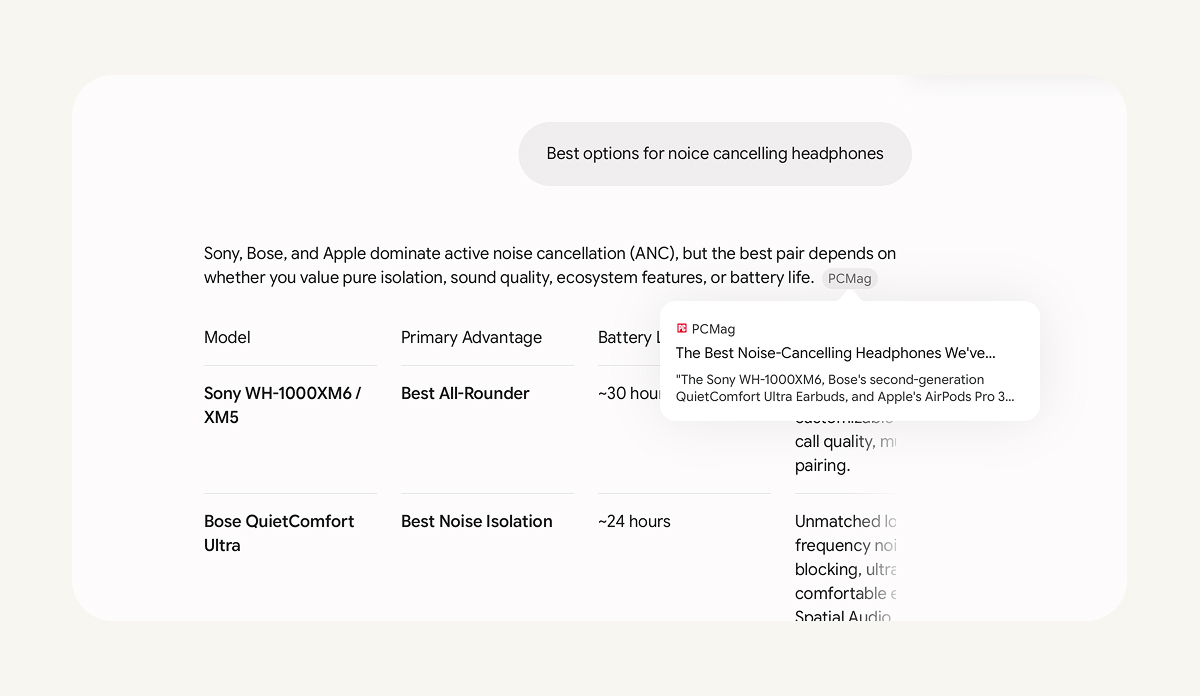
Here the method changes radically from classic PR. The most reliable way to audit the sentiment a model returns is to systematically launch a battery of prompts to different LLMs and record what attributes they associate with the brand and how frequently. In an audit for a client in the lighting sector, we discovered that ChatGPT described it as the “expensive and aspirational” option, while Perplexity presented it as an “investment justified by its quality.” Both responses are technically positive, but the first shifts the decision to emotional territory and the second to rational.
Search engines
Sentiment is read by combining the signals Google returns when someone searches for the brand name: autocomplete suggestions, People Also Ask boxes, featured news, the AI-generated overview. All these clues reveal what questions the public has about the company. Added to this is the first organic page: whether the top-ranked results are owned content, what position competitors occupy, how reviews appear, and what’s published in the news tab. Read together, this mosaic shows the sentiment Google is returning to anyone who types your brand name.
In an audit for a client in the EdTech sector, the People Also Ask boxes when searching for the brand name included questions like “Is it reliable?” and “How much does it cost?” Neither question had an answer on the client’s website. Users arriving at those results continued with the same doubt. That gap between what Google asks about your brand and what your brand answers is one of the most actionable findings from the audit.
Communities and forums
This is the least controllable environment and at the same time the most revealing. What’s said on Reddit, in industry forums, or in niche communities functions as a thermometer of real sentiment, because there are no journalists or communications departments filtering the message. Reddit constantly fights against coordinated manipulation attempts, which adds a layer of credibility for the models. That’s why it appears so often in generative AI responses when asked for product opinions or comparisons. Knowing how many times LLMs turn to these communities to talk about your sector is part of any complete audit.
In the case of a client in the cosmetics sector, a Reddit thread in which a user attributed an incorrect attribute to the brand appeared cited by Gemini every time it was asked about its essence and results. The error had been corrected for months, but the thread remained live and the model had no signal that the information was outdated. The strategy in these cases is to generate more recent and authoritative content that the model will prefer.
What to do when the attributes aren’t the desired ones
Once the audit is done and the gap detected, the next step is to design the strategy to correct it. At Human Level we work with several levers, and the combination of one or another depends on the client’s starting point and the sector in which they operate.
- We start with producing content aligned with the attributes we want to reinforce and designed to be cited. For example, studies with proprietary industry data, trend reports, technical guides that resolve frequent category questions, reactive responses to current events (newsjacking), and collaborations with industry associations and institutions. A piece of this type has a much higher probability of being picked up by a leading outlet and, once published, of appearing cited in AI responses. The same content that achieves press coverage ends up feeding the source that Gemini draws from when someone asks about your sector. A client in the health sector published a study on average wait times for clinical care in Spain. The piece was picked up by three mainstream media outlets in one week. Three months later, when we asked Perplexity for industry data, it cited that study as a source. The piece was designed with the journalist in mind, but the collateral effect on AI was where the real return was.
- From there, we identify which media AI models use as preferred sources when talking about your brand’s category and concentrate editorial efforts there. If AI systematically turns to Xataka or Computer Hoy to build responses about your vertical, it makes more sense to work on presence in those outlets than to chase mainstream publications with higher circulation but less weight for the models. That information comes from the strategic prompts we design with each client’s Searcher Persona.
- And there’s one front many clients overlook: managing brand spokespeople. When a recognized industry expert appears in interviews, podcasts, conferences, or opinion columns using the attributes we want to install, the narrative starts to take hold with both journalists and language models. The spokesperson’s public presence completes the process: news media, AI, and communities or forums end up describing the brand with the language the brand itself has planted. With a client in the education sector, we worked for six months on the public presence of their leaders through opinion articles in niche media. After that period, when AI is asked about prominent figures in that sector, the brand name starts to appear alongside the usual ones. The spokesperson thus becomes a brand lever whose effect transcends the individual.
One thing should be clear before starting any process of this type: correcting sentiment takes time. One-off campaigns or isolated actions don’t shift an established narrative. In Digital PR, results are seen in the medium term and require sustained presence in the right sources until the new attribute ends up displacing the previous one in both newsrooms and models.
Sentiment changes. So does the audit
My impression as a brand audit specialist is that most communications departments still aren’t aware of how much the landscape is changing. And that shows up especially in one thing: they’re still auditing sentiment to get a snapshot, but digital PR decisions are made by observing how that snapshot evolves week by week.
Sentiment changes every time the sector generates news, a competitor launches a campaign with impact, and Google or the major LLMs adjust how they build their responses. The audit must be continuous, and the data it yields must enter the editorial calendar at the same pace as the sources evolve.
Influencing before the narrative solidifies
Brand sentiment today is measured in attributes, in the consistency between what the media say and what the models say, and in the weight communities have on the training of those models. A company’s digital findability depends as much on appearing in the places where its audience searches as on what that audience finds when the brand appears.
The company that knows all this data about itself positions its narrative from a position of advantage over one that only monitors social media mentions or tracks its classic share of voice. It will be able to act before a misaligned attribute solidifies and detect new narrative opportunities that the competition hasn’t yet occupied.
At Human Level we conduct customized audits for each client to answer with data the questions that more and more management committees are asking: when someone asks about my industry, what does AI respond? Does it say about me what I would want it to say?