Tabla de contenidos
What is Baidu?
Baidu (its literal translation is “one hundred times”) is the first search engine used in China, based in Beijing. It was created by Robin Li and Eric Xu in 1999 and offers web search, news, images, songs, locations (maps) among other functions. It currently manages a 60% share of the search market.
Origin, statistical data and other curiosities
Origin
Its name comes from an 800-year-old classical Chinese poem by the poet Xin Qiji. This poem was about a man looking for the love of his life, in whose text appeared the etymological basis of the name “...hundreds and thousands of times, for her I searched in the chaos…”.
Baidu was founded in early 2000 by Robin Li. It is currently based in Beijing but also has offices in Shanghai, Guangdong Province and in countries such as Japan, USA, Thailand, Brazil, Egypt and Indonesia. In 2014, it already had around 40,500 employees and in August 2005 it went public.
Ranking
At the end of 2015 and according to the Alexa ranking, Baidu.com ranked No. 4 in the world ranking of most visited pages, just 3 places behind Google, which is in first position.
Database
Baidu contains data on more than 740 million web pages, 80 million images and 10 million multimedia files.
Products
Like Google or other search engines such as Yahoo or bing, Baidu develops other complementary products. We have among others Baidu Maps, Baidu Tieba or PostBar, a great forum; Baike Baidu, Baidu’s encyclopedia; Baidu Knows, something like the equivalent of Yahoo Answers; or Baidu Yun, for storing data in the cloud.
In addition, Doodles also exist in Baidu and with them it celebrates important events in the global calendar or in its own calendar.
Baidu Search Engine Optimization
As for the SEO we have to practice on Baidu to get the best possible SEO, we could talk at length. However, we will summarize a few points as far as possible:
Server and domain
Hosting our website on a local Chinese server and with ccTLD .cn or .com.cn will be the best option.
Site translation
There are multiple dialects and official and unofficial languages. It would be best to have the website translated into simplified Chinese, since it has a greater territorial expansion and a higher spoken and written level. We recommend that you always rely on a native speaker for the keyword consulting phase as well as translations.
Keyword consulting
You can use their keyword traffic estimation tool to do the inciial consultancy and define the SEO strategy.
Contents
Regarding the contents, we must choose them very carefully because the censorship that the Chinese government applies on them can harm the SEO of your website. If, among other reasons, you use a word on the government’s blacklist, you can be sure that Baidu will de-index your content. Regarding their quality, they must be original and their length should not be less than 300 words.
As Baidu does not have any tool for webmasters where we can have an updated index, we will have to make use of this tool to submit the URL of our domain as often as we optimize its content.
Duplicate content
Duplicate content is treated especially harshly on Baidu. Make sure that your content is unique and of high quality, and also make sure that other companies do not copy it.
Site speed
Site speed is a very important factor for Baidu. We must fine-tune Web Performance Optimization to the maximum.
SEO Fields
- Titles must adhere to a maximum limit of around 35 Chinese characters.
- Meta descriptions should not exceed 80 characters.
- Meta keywords, for the time being, are still a relevant factor in Baidu. We will stick to 3 or 4 search phrases, avoiding keyword keyword stuffing.
- The alt attribute of images is also a positioning factor.
Linkbuilding
Linkbuilding is still very rudimentary in Baidu. It currently values a high quantity of external links more than the quality of those links. This, as has happened with other search engines such as Google, can change radically from one day to the next.
PPC or Ads on Baidu
Baidu’s Google AdWords counterpart is called Tuiguang (百度推广), and the two are similar in their main aspects. Tuiguang’s tool allows you to perform keyword research, stipulate negative keywords for your campaign, generate reports, adjust keyword matching and bidding or segment by geographic area and other interests. In addition, the formats are also very wide: texts, banners and even videos.
As with AdWords, Tuiguang can display ads in both Baidu search results and Display (third-party sites affiliated with Tuiguang), which is illustrated in the following screenshot.
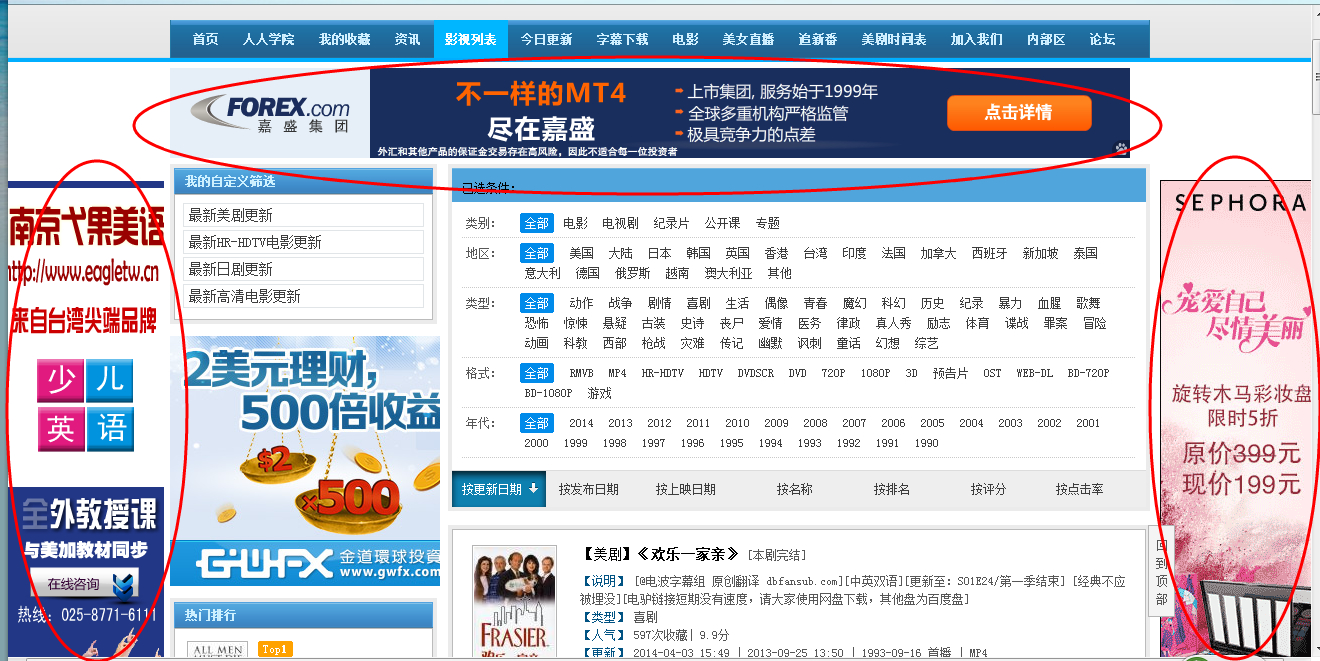
However, the service is only available to users with business addresses registered in China or other East Asian countries, while Google AdWords can be used worldwide.
Trading on Baidu
The main difference between this and other search engines lies in the bureaucratic processes that we have to go through in order to operate in the Chinese search market. In order to publish on the Internet we need a China Content Publishing License, which can be applied for from the Ministry of Industry and Information Technology.
References
Official Baidu Corporate Information